

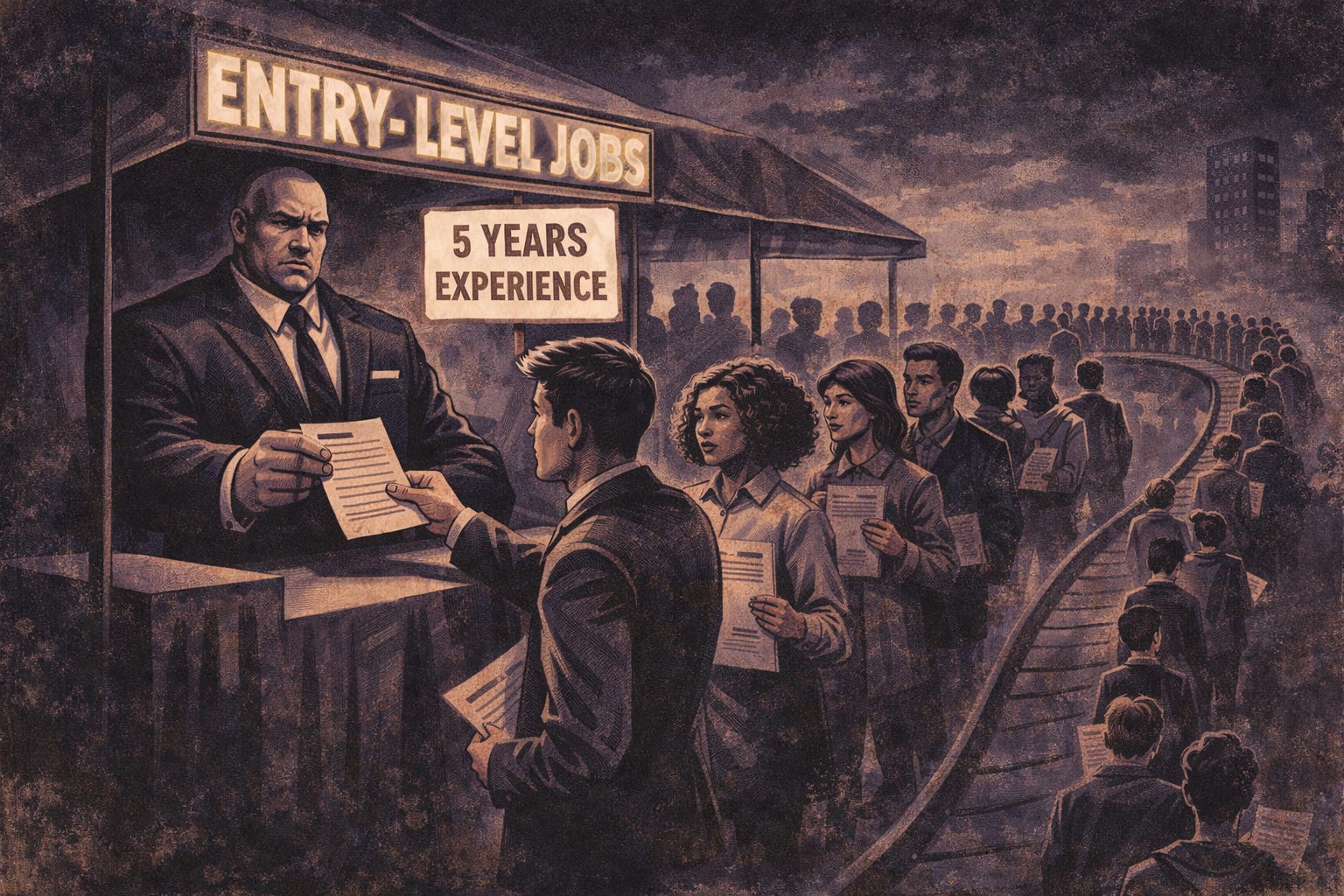
“Entry-level” is one of those phrases that has undergone such complete semantic inversion that linguists should study it alongside “literally” (which now means figuratively) and “free shipping” (which you most definitely paid for).
Large-scale analyses of job postings found that over half of all jobs labeled “entry-level” require multiple years of experience. In IT, a similar large-scale analysis showed that 94% of entry-level jobs required at least a year of experience. That’s less of an entry-level job market and more of a bouncer at a club saying “Sorry, this club is for people who already got into the club.”
Conventional wisdom goes like this. Modern work is complex. Companies need qualified people. You have to prove yourself. This is just how competitive markets work, and if you can’t hack it, maybe you’re not cut out for the job.
And when a comprehensive analysis of workers revealed that over half of college graduates are still underemployed one year after graduation—working jobs that don’t align with their education—it’s easy to believe the problem is you.
Here’s what’s actually happening: Experience requirements aren’t about whether you can do the job. They’re solving an HR problem. And HR’s problem is that companies won’t fund adequate hiring capacity. The “3-5 years experience” requirement isn’t a skills assessment. It’s a filter. A crude, lazy filter that externalizes the cost of hiring onto you, while companies pocket the savings and complain about talent shortages.
So apply anyway. But we’ll get to that. First, understand you’re not deficient. The system is. And it’s broken in very specific, very profitable ways.
We Don’t Want to Train You
When you see a job posting requiring five years of experience for an entry-level role, you’re not looking at a mistake. You’re looking at a solution to a problem.
The average corporate job posting receives hundreds of applications. At big-name companies, it’s well into the thousands. Recruiters spend seven seconds per resume. At that rate, processing 500 applications is a full work week of doing nothing but scanning minimal text and making snap judgments—like corporate Tinder. Research shows virtually all Fortune 500 companies now use Applicant Tracking Systems to handle this volume, automatically screening most applicants as “unqualified.”
The experience requirement exists as what hiring managers—and I love this part—explicitly call a “first line of defense.” Not “first line of quality control.” Defense. Against whom? You. HR departments have adopted the language of military strategists to describe filtering out college graduates. This is the level of threat assessment usually reserved for foreign adversaries, not 22-year-olds with English degrees.
Industry surveys confirm that companies use experience requirements to “discourage applicants” and filter volume, not to assess job capability.
Here’s where it gets beautiful in its cynicism: Companies don’t even enforce their stated requirements. Career counselors recommend the “85% rule”—if you match 85% of the job description, apply anyway. Research found that 42% of jobs will hire applicants who don’t have the requested experience.
The requirements are theater. But the theater works. Applicants self-select out of jobs they’re qualified for. The ATS systems auto-reject based on keyword searches. And surveys reveal it’s breaking everyone. Nearly half of entry-level job seekers now lie on their resumes just to get past filters designed to eliminate them.
Everyone is lying to everyone, and everyone knows everyone is lying, but we all pretend the system works. It’s like cryptocurrency, but for employment.
The requirement isn’t about whether you can do the job. It’s about whether the company can defend the hiring decision if something goes wrong. More on that later. First, let’s talk about how we got here.
How Training Became Someone Else’s Problem
Your grandparents could walk into a bank with a high school diploma, get trained on the job, and become managers. Your parents got college degrees that led to corporate training programs that built careers. You? You need five years of experience for entry-level positions, receive no training, and face a decent chance of being underemployed for the next decade. The entry door didn’t disappear; it was locked from the inside.
A government report documented a 42% decline in employer-sponsored training between 1996-2008. That kind of collapse is normally reserved for industries disrupted by technology, like Blockbuster or taxis. Except in this case, nothing disrupted training. Companies just... stopped doing it. Recent data shows this hasn’t improved.
Why did this happen? Three reasons, each more depressing than the last.
First, declining employee tenure in the 1980s and 90s made companies ask “why train someone who’ll leave?”
Second, quarterly earnings pressure meant training budgets became easy cuts to juice short-term profits. (R&D went the same way, but that’s another story.)
Third, global competition pushed American companies into a race-to-the-bottom. Training workers costs money. As one analysis put it, this represents “a classic case of market failure. Firms invest less in training than is optimal from a societal and economic perspective.”
The cost of training didn’t disappear. It got externalized. Workers now bear it through unpaid internships. Universities bear it through “job-ready” curriculum pressure. Previous employers bear it by training workers who get poached. And when every company externalizes training simultaneously, nobody trains anyone. The system doesn’t produce new workers anymore. It just shuffles the existing ones around and blames graduates for not showing up pre-trained to jobs that don’t exist yet.
Capitalism’s Greatest Magic Trick
“Okay, so I’ll just get more credentials.” Great attitude. You’re going to be disappointed by how that works out.
The same research that identified the three-year requirement found something worse: Those requirements creep upward year after year. Three years may turn into four a decade from now. Five shortly after that.
This is happening while college degrees lose value. Analysis shows underemployed college graduates earn only 25% more than high school graduates, compared to the 88% premium that college-level jobs provide. Meanwhile, tuition has increased 141% over the past 20 years. Student debt exceeds $30,000. And research tracking millions of workers found that 45% of college graduates remain underemployed ten years after graduation.
You’re paying more, for credentials worth less, to qualify for jobs you still can’t get. The system has achieved the impossible: a perpetual motion machine where the entry requirements keep rising while the exit value keeps falling. It’s capitalism’s greatest magic trick—making something simultaneously more expensive and less valuable.
Experience Is a Luxury Good
And now for the part where we stop pretending this system is anything other than class warfare.
You can’t get experience without internships. Research shows that roughly half of all US internships are unpaid. Surveys found that 69% of college students can’t afford to take an unpaid internship. A separate University of Wisconsin survey showed most students who wanted internships couldn’t complete them due to financial constraints.
Education data revealed that only 33% of white students from low-income backgrounds take unpaid internships, compared to 60% of Black students and 53% of Latino students who feel compelled to take unpaid work. Data from the Class of 2023 showed paid interns got median salaries of $67,500, while unpaid interns got $45,000—the same as graduates who never interned at all. Working for free doesn’t just fail to help; it actively signals to employers that you’re desperate enough to be exploited.
And even after jumping through all these hoops, the same research tracking 60 million workers found that nearly half remain underemployed a full decade after graduation.
You did everything right. You got the degree. You gained the experience. And ten years later? There’s a nearly 50% chance you’re underemployed. The game is rigged.
The $26 Billion Rejection Industry
The system serves everyone except workers. Companies avoid training costs while maintaining legal liability protection. The HR technology industry sells Applicant Tracking Systems in a market expected to reach $26 billion by 2030. Universities sell degrees as “job tickets” while the actual job market degrades, then they pivot to selling “job-ready” certificates and bootcamps when degrees prove insufficient. Previous employers benefit by hiring workers trained elsewhere, creating a tragedy of the commons where no company invests in training because they assume everyone else will.
Workers lose. Especially young people, people of color, and anyone without family wealth. Here’s what nobody wants to say out loud: When every company externalizes training, nobody is responsible for creating new workers. The pipeline breaks. And then companies complain about talent shortages. With a straight face.
But there’s another dimension that makes this even more cynical. Employment law establishes that companies can face negligent hiring claims if they knew or should have known an employee was unfit for a position. Legal analysts warn that “the costs of defending negligent hiring claims alone can be significant and, coupled with an unfavorable outcome, crippling to a business.”
Hiring someone with “five years of experience” provides a paper trail showing the company exercised reasonable care. Experience requirements aren’t asking “Can you do the job?” They’re asking “Can we defend hiring you in court if something goes wrong?” The requirement protects the company from lawsuits, not customers from incompetent workers. Liability theater.
And then there’s wage suppression. Analysis found that jobs labeled “entry-level” pay 20% less than jobs requiring identical experience but without the “entry-level” designation. Hiring managers candidly admit they’re trying to recruit skilled professionals for the salary of a novice.
20% less. For the same work.
The Entry Door Is Closed
If you’re reading this and thinking “okay, but what do I actually do?” the answer is frustratingly conventional: Apply anyway. If you match 85% of a job description, apply. Companies frequently hire people who don’t meet their stated requirements.
But here’s the more important reframe: This is how entry-level became a luxury good. When you see a job posting requiring five years of experience for an entry-level position, you’re seeing the result of deliberate choices. Companies chose to stop training workers. They chose to underfund HR departments and use crude filtering instead. They chose to externalize costs onto workers, universities, and previous employers. They chose to treat developing new talent as someone else’s problem.
Some companies are experimenting with skills-based hiring. Some states have banned degree requirements for government jobs. It’s not enough. Not even close. Because the structural problem remains: a system that has decided creating new workers isn’t anyone’s job.
The next time you see an entry-level position requiring multiple years of experience, remember that this isn’t about you or your skills. This is about a society that has decided investing in people is someone else’s problem.
Welcome to the entry-level job market. The door is closed. The handle was removed in 1996. The sign still says “entry” because no one has taken it down yet.
This really captures one of the most frustrating parts of the current job market: “entry-level” roles often expect experience that people can’t realistically get without already being hired somewhere first. Add ATS filtering on top of that, and qualified candidates can be rejected before anyone actually looks at what they can do.
Obviously a tool can’t fix the larger structural problem, but it can at least help reduce avoidable rejections. I’ve used https://atschecker.app/ to compare a resume with a specific job description and see whether important skills or requirements are being communicated clearly enough. When the system is already filtering so aggressively, making sure the resume accurately reflects the role feels less like gaming the process and more like giving yourself a fair chance to be seen.