

You find tickets to a show you’ve been waiting months to see. Face value: $85. You click through to checkout. Total: $112. That’s a 32% markup for the privilege of paying for concert tickets with your own money.
Service fee. Facility charge. Order processing fee.
The holy trinity of “go fuck yourself.” You pause. You curse. You pay anyway.
You already know the Ticketmaster story. The fees, the frustration, the ritual of outrage. This isn’t another entry in that genre. It’s about why directing all that anger at Ticketmaster alone lets the real decision-makers off the hook.
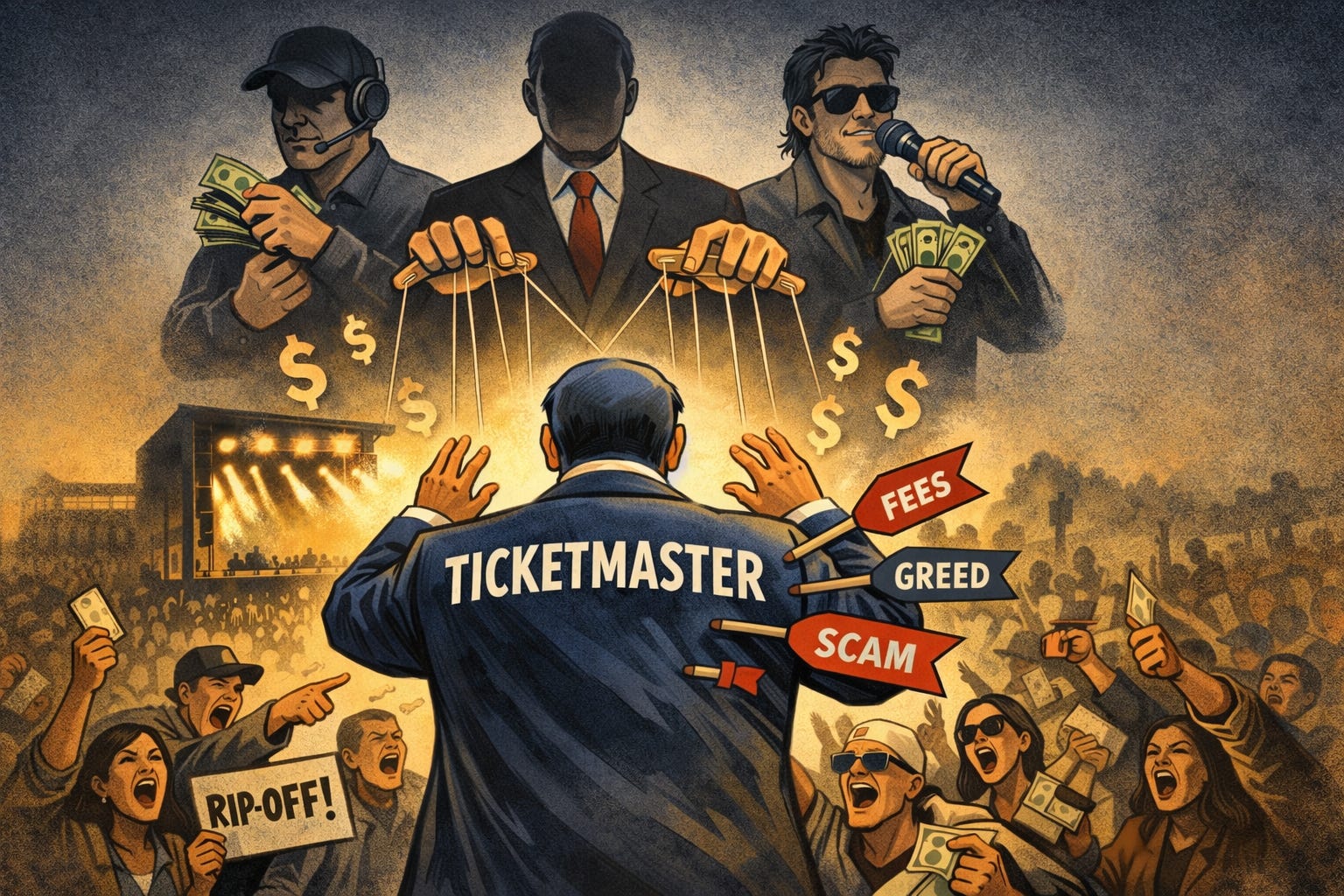
Two former Ticketmaster CEOs have publicly admitted it. The company was designed, from the ground up, to absorb hatred on behalf of venues, promoters, and artists. Your rage is directed at a company paid to be the bad guy.
Once you see how this arrangement actually works, you’ll understand why yelling at Ticketmaster changes nothing.
Misdirection
Ticketmaster is a greedy monopoly that exploits its market dominance to charge outrageous fees in the name of convenience. It pockets the money, laughs at customers, and faces no consequences because there’s no real competition.
All true. Mostly, anyway.
Here’s what everyone yelling at Ticketmaster misses though. The company keeps a small fraction of those fees. The venues take most of it. Ticketmaster is paid to make sure you never figure that out.
In 2009, Irving Azoff—then CEO of Ticketmaster—testified before Congress. What he said should have ended the “Ticketmaster is evil” discourse forever, replacing it with something more accurate.
“Ticketmaster was set up as a system where they took the heat for everybody. In that service charge are the credit card fees, the rebates to buildings, rebates sometimes to artists, sometimes to promoters. We’re like the IRS. We deliver the bad news,” Azoff testified.
Comparing yourself to the IRS is a choice. Doing it in front of Congress is a flex.
This wasn’t a slip. It was sworn Congressional testimony. Azoff wasn’t apologizing; he was explaining the business model to lawmakers who didn’t seem to understand it. (They still don’t.)
Fourteen years later, Fred Rosen—the CEO who built Ticketmaster into a juggernaut between 1982 and 1998—gave an interview to CBC Radio. He offered an identical explanation to Azoff. Rosen said, “I [made] it so that Ticketmaster would take the hit for everyone, but Ticketmaster never got all the money.”
When pressed on whether this was fair to consumers, Rosen didn’t blink: “Do you not understand this is a business?”A sentence that has never once preceded good news for the person hearing it.
Two CEOs. Fourteen years apart. Same admission.
Eric Budish, an economist at the University of Chicago who studies ticket markets, told the Seattle Times: “Ticketmaster is effectively paid to be a punching bag.
Follow the Money
So where does the money go? On a $100 ticket with $27 in fees—about average, according to the US Government Accountability Office—here’s the breakdown, per Ticketmaster’s own disclosures:
YOUR $100 TICKET → $127 AT CHECKOUT
Where the $27 goes:
$12-15 → Venue (facility fee + their cut of service fee)
$5-7 → Ticketmaster (their actual take)
$2-3 → Credit card processing
$2-5 → Artists/promoters (when they’ve negotiated for it)
WHO GETS THE MOST: The venue
WHO GETS BLAMED: Ticketmaster
Ticketmaster, notably, does not include this chart on its website.
The venue receives “around two-thirds of the service charge.” Ticketmaster keeps “about 5% of the all-in price.” On a $127 ticket, that’s roughly $6.
This arrangement has existed for decades. What’s changed is the scale.
In 1977, Ticketmaster’s first show—ELO in Phoenix—featured a $6.50 ticket with a $0.25 service charge. Four percent. Today: 27%.
That’s not inflation. That’s a 575% increase in the fee-to-ticket ratio because venues wanted more, promoters wanted a cut, and eventually artists started negotiating for a share too. Ticketmaster got bigger fees to split. Everyone won. Well, except you.
Economists call this extraction. Everyone else calls it getting mugged, but politely.
The Psychology of Getting Played
There’s a reason Ticketmaster shows you an $85 ticket and hit you with a $112 charge at checkout instead of just listing the all-in fee from the start. It’s called drip pricing. It’s well-studied. And it works.
A 2020 study in Marketing Science found that consumers who see fees early in the checkout process choose cheaper-looking options, even when the total cost ends up higher. You’ve already invested the time. You assume everyone else charges the same. You click “purchase.”
A separate study confirmed exactly what you’d expect. “With drip pricing, consumer surplus is lower, and seller profits are higher.”
The FTC, in its December 2024 rule on junk fees, called drip pricing “the quintessential example of bait-and-switch pricing,” and then proceeded to do nothing about it. Bait-and-switch pricing is illegal. Drip pricing? Fair game.
Look, I just report on nonsense, I don’t make it up.
It (Somehow) Gets Worse
Live Nation—Ticketmaster’s parent company since 2010—controls roughly 80% of primary ticketing at major concert venues. It promotes 60% of all major concerts. It operates 265+ venues. It manages 400+ artists. The technical term is “monopoly,” a market condition where the shrug is built in.
The DOJ sued Live Nation in 2024. 40 state attorneys generals joined. Attorney General Merrick Garland declared: “It is time to break it up.” The lawsuit is ongoing.
And that’s great. Except, it won’t really fix anything.
Live Nation’s defense is partially correct. In its response to the lawsuit, the company pointed out that “the bulk of service fees go to venues” and that artists, not Ticketmaster, set face value.
Industry analysts confirmed. Analyst Bob Lefsetz, wrote: “The money’s just going to be shifted around, but it will all be behind the scenes and you’ll end up paying the same.”
The problem isn’t just Ticketmaster. It’s the arrangement. Everyone benefits except you. And yes, that includes the artists who cry foul and then jack up ticket prices behind-the-scenes.
Robert Smith, frontman of The Cure, made headlines in 2023 when he negotiated partial refunds for fans after fees on $20 tickets exceeded the ticket price. He rejected dynamic pricing. He demanded lower fees. He got Ticketmaster to comply.
Most artists don’t.
In a 2024 interview, Smith explained why:
“It was easy to set ticket prices, but you need to be pig-headed. We didn’t allow dynamic pricing because it’s a scam that would disappear if every artist said, ‘I don’t want that!’ But most artists hide behind management. ‘Oh, we didn’t know,’ they say. They all know. If they say they do not, they’re either fucking stupid or lying. It’s just driven by greed.”
The bad cop arrangement doesn’t just protect venues. It protects artists too.
The New Rule (And Why It Won’t Help)
On May 12, 2025, the FTC’s junk fees rule took effect. Ticket sellers now have to display the total price upfront. No more hiding fees until checkout.
The rule doesn’t cap fees. Doesn’t ban any fee types. Doesn’t touch dynamic pricing.
Ticketmaster supported the rule. This is like a casino supporting better lighting. The house edge stays the same, but at least you can see how much you’re losing.
Experts are skeptical that it’ll matter. Andrew Mall, a music industry professor at Northeastern, told CNBC: “If there are any consumers who have been expecting fewer fees as a result, they will be disappointed.”
You’ll see the full ticket price now.
Prices will stay the same.
Progress.
Now What?
Boycotting Ticketmaster is functionally impossible. Major venues have exclusive contracts lasting a decade or more. Ticketmaster’s competitors charge similar fees anyway. (The Hustle found SeatGeek averaged 37% fees, actually higher than Ticketmaster.) But this is what choice looks like when all the choices are bad.
Buying at the box office sometimes reduces service fees. But facility charges still apply. And many venues don’t have box offices anymore.
What might actually work:
Complain to venues, not Ticketmaster. The venue sets the fee structure. The venue keeps most of the money. They should hear from you directly about exorbitant service charges for the privilege of entering and buying exorbitantly-priced beer.
Ask artists about their fee arrangements. Robert Smith proved artists can negotiate lower fees if they’re willing to fight for them. Most aren’t. Public pressure might change that. Social media is a tool.
Support the DOJ case. A 2023 poll found 60% of Americans support breaking up Live Nation—72% of Democrats, 50% of Republicans. Even if it doesn’t lower fees immediately, it may create market space for alternatives.
Push for state-level all-in pricing laws. Connecticut, New York, and Tennessee already have them. More states are considering them.
Ticketmaster isn’t the cause of high ticket prices. It’s the infrastructure that makes them feel unavoidable. By concentrating consumer anger on a single, highly visible company, the rest of the industry gets to quietly agree on outcomes without ever owning them publicly.
Artists can shrug, venues can plead necessity, promoters can point elsewhere, and everyone can say their hands were tied. That story holds until you follow the incentives instead of the headlines.
Once you do, it becomes clear that Ticketmaster isn’t pulling the strings. It’s just standing exactly where the strings need it to stand.