

In 2014, researchers at Yale and Cornell did something slightly unhinged: They measured the exact angle that cereal mascots look down from their boxes. Cap’n Crunch, Tony the Tiger, the Trix Rabbit, all positioned at a 9.6-degree downward angle.
Not 9 degrees. Not 10. Exactly 9.6.
Why? Because that’s the angle that creates direct eye contact with the average seven-year-old standing in the cereal aisle. When mascots make eye contact with children, the study found, brand trust increases 16%, and feelings of connection jump 28%. Children’s cereals sit 23 inches off the ground in the average supermarket—kid eye level. Adult cereals? 48 inches. Meanwhile, Grape Nuts sits at 73 inches because only people who have given up on life buy cereal that tastes like eating gravel with a spoon.
Scientists. With protractors. Measuring cartoon rabbits.
Let’s be clear about what’s happening. Food companies employ researchers to engineer trust in seven-year-olds who cannot possibly understand brand loyalty or manipulation. While parents try to make healthy decisions, brands are out here engineering emotional bonds with pre-adolescent children.
And it works. Your kindergartner has stronger brand loyalty to a cartoon rabbit than most people have to their spouses.
The 9.6 degrees isn’t happenstance. And it’s just the beginning.
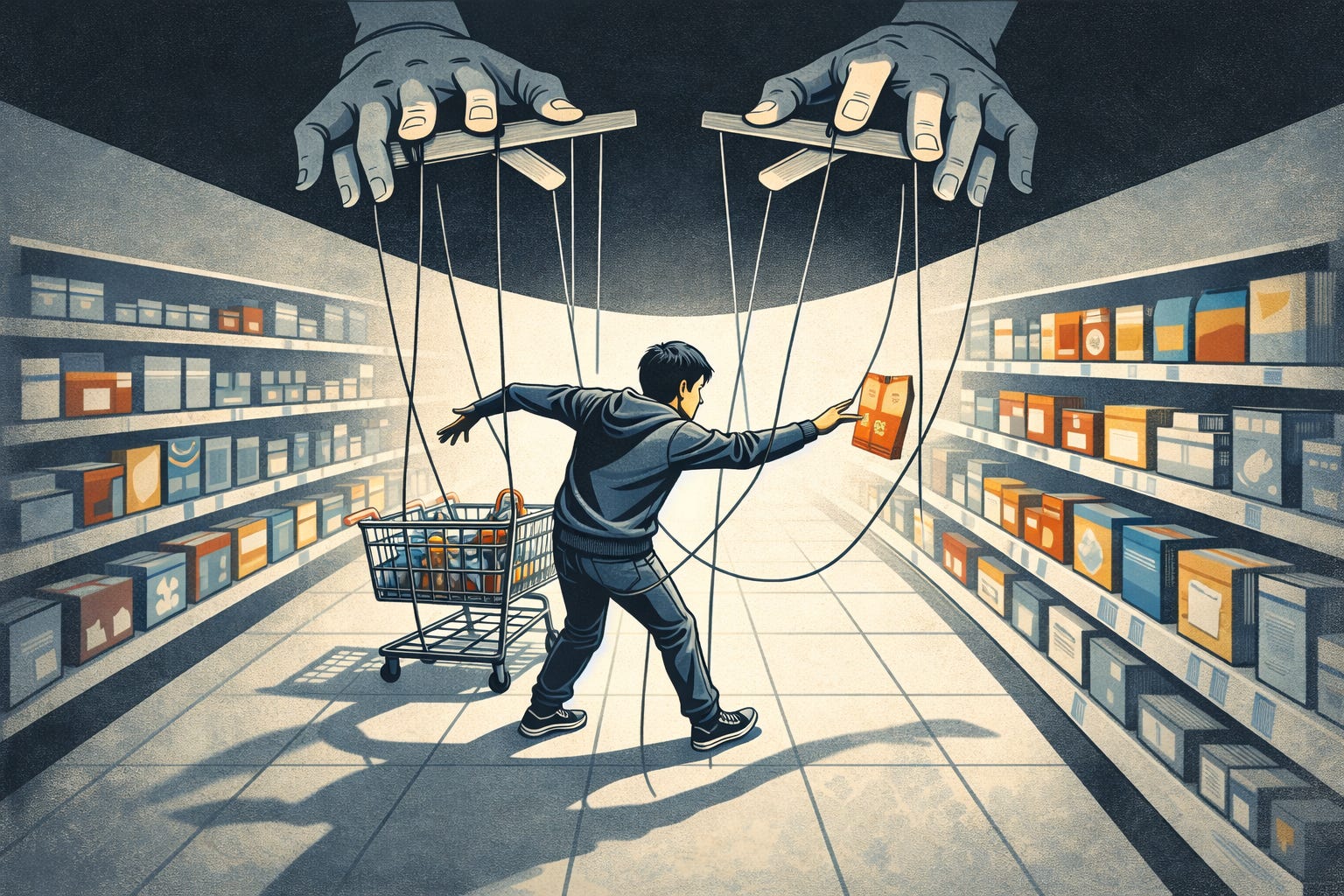
Welcome to the grocery store, where nothing is an accident and you are the experiment.
You Came Here for Milk
You need milk. Just milk. Back-left corner. You know where it is, you’ve walked this path a thousand times.
By the time you reach the dairy case, your cart has Oreos you didn’t plan to buy, a rotisserie chicken that smells good, and a six-pack of La Croix. Your $5 milk trip just shot up to $28. And you’re still not to the checkout aisle.
This isn’t failed willpower. It’s science.
Essential items like milk, eggs, and bread get placed at the store perimeters on purpose. They force you to walk through the most square footage to get them. You’ve heard the adage a million times to avoid the interior, and shop the perimeter of a grocery store. Well, grocery stores know that too. That’s why they entice you with end caps, checkout lanes full of snacks, and a scenic path around the store that forces you to casually glance around while walking.
The industry calls this “building the basket,” which is a polite euphemism for “engineering mild financial amnesia aisle-by-aisle.”
Stores will tell you it’s about refrigeration logistics. Sure, that’s part of it. But retail research confirms that “department adjacencies are often purposely violated to encourage shoppers to travel through most of the store.”
The dairy pilgrimage you were just on. Not an accident.
And while you walk, they measure. Retailers use heat-mapping to track where you go while in the store. They use eye-tracking studies to nail down optimal shelf placement. Your loyalty card? It’s logging every purchase. You’re in a psychology experiment being graded in real time, and the test adjusts itself based on previous performance.
The results are quantifiable. Retailers make up to 10% more profit just from smarter layouts. Product exposure and sales increase with path length. The whole trip is designed to maximize spending, not convenience.
Then there’s eye level. Products at eye level sell far better than anything you have to reach for on the top or bottom shelf. Best-selling items get prime real estate. Store brands, even though they’re higher-margin, go down low where you have to crouch because they don’t move as many units as national brands. Because when’s the last time you bought generic Dr. Pepper and didn’t hate yourself after?
But it’s not just what you see. They’re coming for all five senses.
Bakery aromas get pumped toward the front of the store to make you hungry.
Stores run slightly cold because when you’re uncomfortable, you buy faster and get out. (More emotional decisions. More impulse purchases.)
Warm colors like red and yellow trigger appetite.
Green signifies healthy, whether it’s true or not.
Background music, lighting, the whole layout—all calibrated to trigger impulse buying. Our ancestors fought saber-toothed tigers and we’re at the supermarket getting seduced by climate control and fake croissants.
Does it work? Three out of four shoppers make unplanned purchases with each grocery trip. Impulse buying is emotionally-charged and spontaneous. Worse, it happens even when you know it’s happening. Behavioral psychologists who study this for a living still come home with cookies they didn’t plan to buy.
Invisible Price Increases
Let’s talk about “shrinkflation.” Here’s the mechanism: Shrinkflation means reducing the size of a product while keeping the price the same, or raising it. You’re paying more per ounce of product, even if the price stays the same. It’s inflation you can’t see coming.
It’s not new, but it went wild between 2021 and 2023 under perfect conditions: supply chain chaos driving up costs, inflation giving companies cover, and consumers too exhausted to track the changes. So companies shrank their packages. Then, even as supply chains stabilized and manufacturing costs dropped, the packages stayed small. The consumer price cut never came.
And there’s a reason it works. Consumers are more sensitive to changes in price than changes in quantity. Your brain instantly notices when $5.99 becomes $6.49, but tends to miss that 16-ounces became 14. Manufacturers know this. Recent research confirms consumers barely react to downsizing compared to an equivalent price increase.
Look at the damage. 60% of household paper products shrank during the pandemic. 44% of breakfast foods. 40% of snack foods. And while only about 5% of total goods shrank, those items that did represent a disproportionate amount of the ones you’re actually buying on a consistent basis.
Let’s name names.
Gatorade went from 32-ounces to 28. 12% less sports drink, same price.
Breyers ice cream shrank three times. From 64-ounces to 56, and then down to 48.
Bounty paper towels went from 180 sheets per roll to 164.
Doritos kept the same size bag, but 11.5-ounces dropped to 9.75.
Chobani yogurt shed nearly an ounce, from 6-ounces per cup to 5.3.
And coffee. Coffee went from 16-ounce containers, to 13 ounces, and then down to 11 ounces. That’s 31% less coffee in the same-sized package. You’re getting a third less of the only substance that keeps you from driving your car into a lake most weekdays, and they didn’t even have the decency to make the container smaller so you’d notice.
I’ll do the math for you. If a package quietly shrinks by 25%, the old buying patterns have to adjust with it. Buy one container weekly? That’s 52 a year. You now need 16 containers annually to get what 12 months of the old size used to give you. At $8 per container, that’s $128 more per year. On just coffee.
Now do the math across cereal, chips, paper towels, yogurt, laundry detergent, and everything else that shrank in size while you weren’t looking.
This is the point where some argue that shrinkflation only contributed 0.01% to overall inflation between 2015 and 2021. So, is shrinkflation overblown?
No, not really. In the categories most affected, shrinkflation added 1.6 to 3 percentage points to inflation. Per-unit price increases ranged from 12% to 32% for paper towels and coffee respectively. The impact isn’t spread evenly. It’s concentrated in the products you buy most often, not the outliers that didn’t shift in size or price. Your personal grocery cart got hit much harder than national statistics suggest.
And that’s where it gets really unfair. If you can only afford the smallest package sizes, you pay more per ounce. A 16-ounce jar of peanut butter costs $4.99—that’s $0.31 per ounce. A 40-ounce jar costs $9.99—$0.25 per ounce. When the 16-ounce jar shrinks to 14-ounces, but the price stays at $4.99, you’re suddenly paying $0.36 per ounce. That’s a 16% price increase without actually raising prices.
Shrinkflation isn’t just sneaky. It’s regressive.
Oh, and the “family size” package? It’s often more expensive per ounce than the regular size. Retailers exploit a cognitive shortcut they previously trained us to believe: Bigger is always cheaper. And it usually is. Except when it’s labeled “family size,” “value size,” or similar—and then all bets are off.
Check the unit price, always.
How to Fight Back (Sort Of)
You can’t opt out of eating. But you can fight back. Kinda.
And look, I’m not the guy who writes the listicle about how to save money at the grocery store. But Consumer Reports did. Twice, in fact. Check them out here and here.
But what I can tell you is that even armed with this knowledge, you’re fighting a losing battle. The best you can hope for is that you have the discipline to stick to your list and not make a single detour. Or, try grocery delivery, if it’s available in your area (and affordable).
The System Works Even When You Know How It Works
None of this is conspiracy theory territory. Store layout, artificial sensory enhancement, and shrinkflation are documented business strategies backed by decades of research. Entire consulting firms exist to optimize them. At a certain point, strategies designed to be subtle become impossible to ignore. And governments are beginning to take notice.
In 2024, France passed a law that requires stores to label downsized products. In the US, senators proposed a “Shrinkflation Prevention Act.” It died immediately, because of course it did. But the fact it was proposed at all says something about how visible it’s become.
Here’s what’s wild: The system is designed to work even on people who know exactly how it works. Behavioral psychologists who study impulse buying for a living? They still impulse buy. The people who install heat-mapping technology still get tracked by it. And that 9.6-degree gaze? It still works on your kid even when you’re standing there knowing precisely what it’s engineered to do.
So your suspicion was correct. You’re not getting worse at budgeting. You’re not imagining things. You’re not paranoid about the chip bag feeling lighter. The package did shrink. That cereal mascot is angled to look into the soul of your seven-year-old.
The exhausting part isn’t even that this is happening. It’s that it’s always been happening, we just didn’t have the words for it until recently. Every single grocery trip you’ve ever taken has been carefully choreographed. The milk placement. The music. The deliberate cold that makes you shop faster. Every bit of it, planned.
Grocery stores, consulting firms, and product manufacturers have been playing this game for decades. Go easy on yourself. You just learned the rules.
I love this!
This will definitely come in handy!!
Thanks for sharing!
Great facts about marketing tactics in marts,Great read...😊