

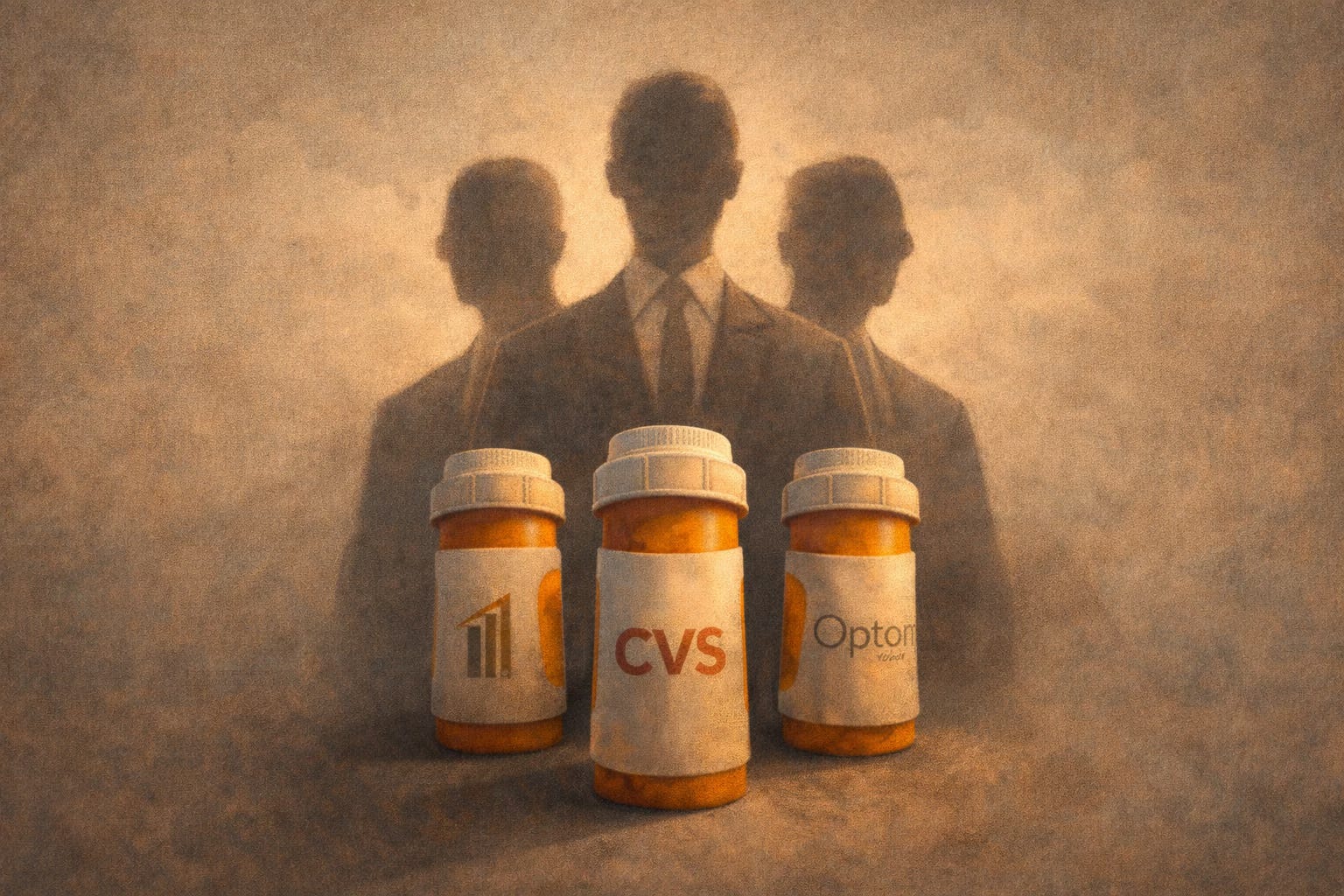
In March 2025, a group of JP Morgan Chase employees sued their own employer. The claim: JPMorgan’s health plan, managed by CVS Caremark, charged them $6,229 for a 30-unit supply of generic teriflunomide, a multiple sclerosis drug.
The same drug, same quality, at ShopRite: $29.24. At Mark Cuban’s Cost Plus Drugs: $11.05.
That’s a 200x markup at the pharmacy counter and a 564x markup over the online price. Same pill. Same milligram. Same disease. The complain notes that JPMorgan pays Caremark roughly $3 million a year in administrative fees, plus “many millions more” in fees Caremark collects through the pricing itself. Which is a bit like paying a locksmith to change your deadbolt only for him to sell your house key on the side.
JPMorgan is the largest bank in the United States. $240 billion in annual revenue. An army of actuaries whose entire job is finding inefficiencies in exactly this kind of spending. If they couldn’t see it, what chance does the HR department at your company have?
A similar lawsuit against Jonson & Johnson’s health plan turned up the same pattern: Express Scripts charged J&J employees $10,200 for a 90-day supply of teriflunomide that Wegmans—a grocery store chain—sold for $40.55. The complain even included a line you don’t normally see in court filings: “$10,200, which is not a typo.”
You’ve probably heard that a pharmacy benefits manager (PBM) exists to negotiate your drug prices down. That is the single most expensive lie in American health care.
The Tollbooth Between You and Your Medication
Here’s what PBMs say the job is: negotiate drug prices, build lists of covered medications, process claims, and save everyone money. The PBM trade group claims the industry cuts drug costs by 40% to 50% and delivers $10 in savings for every $1 spent. PBMs manage prescriptions for 289 million Americans. The pitch is simple. The PBM stands between you and Big Pharma, on your side. This is technically true in the same way that a tollbooth stands between you and the highway.
Here’s what PBMs actually do.
Three PBMs (CVS Caremark, Express Scripts, and OptumRX) handle about 80% of all prescriptions filled at U.S. retail pharmacies. A 2024 Journal of the American Medicine Association (JAMA) study analyzed 14 billion prescriptions across 91 PBMs and found a market so concentrated it blows past the Department of Justice’s own threshold. Three companies. Eighty percent of the market. A cartel with better PR.
But concentration is only half the story. PBMs are supposed to be neutral middlemen. Middlemen that decide which drugs are covered, which pharmacies patients can use, and how much everyone gets paid.
The three largest PBMs are not neutral. Each sits inside a corporate structure where the same parent company owns the insurance plan, the PBM, the pharmacy, and often even the doctor groups and clinics writing the prescriptions. The company negotiating your drug price, the company paying the claim, and the company filling your prescription are the same company, wearing three different hats.
You probably figured out that CVS Caremark owns CVS pharmacies. But did you know it also owns Aetna, the third-largest insurer in the U.S.? Follow the chain from there. Express scripts owns Cigna. OptumRX owns UnitedHealth Group—by far the world’s largest insurer.
And this is somehow not a conflict of interest.
The FTC found that PMB-affiliated pharmacies captured 68% of specialty drug dispensing revenue in 2023, up from 54% just seven years earlier. These aren’t middlemen. It’s the whole supply chain, negotiating with itself. It’s like hiring a divorce lawyer and finding out they’re married to your spouse.
And then there’s the rebate system, the part where the train really starts running backward.
Drug manufacturers pay PBMs rebates—aka kickbacks—in exchange for getting a drug onto the covered list. These rebates are calculated as a percentage of a drug’s list price. Read that again. A percentage of the list price. In what other industry do you pay your negotiator more when they get you a worse deal? The higher the sticker price, the fatter the rebate, the more money the PBM makes.
USC Schaeffer Center researchers measured the relationship: for every $1 increase in rebates, list prices rose $1.17. The system doesn’t push prices down. It pushes rebates up. And you pay the inflated sticker price.
Look at insulin. Humalog cost $21 in 1999. By 2017 it hit $274, a 1,200% increase. When cheaper biosimilar insulins hit the market, the FTC alleged PBMs “systematically excluded them in favor of high list price, highly rebated insulin products.” Cheaper options existed. The PBMs chose the expensive ones. By 2019, one in four insulin patients couldn’t afford their medication.
Now, PBM defenders will tell you that most rebates pass through to plan sponsors, which helps reduce premiums. Fine. But your copay is calculated off the list price, not the net price. So the rebate might lower your premium by a few dollars a month. Your copay at the pharmacy stays high. One of those numbers you notice. One you don’t.
From Boring to Broken
PBMs started in the 1960s as claims processors: useful, boring, and by most accounts, effective. They saved employers 15% to 20% on drug costs. In the 1990s, drug manufacturers tried to buy PBMs outright. The FTC blocked it. But the unintended consequence was a consolidation wave inside the PBM industry itself. Fewer companies, bigger footprints.
By the mid-2000s, PBM revenue had shifted from flat administrative fees to a cut of each drug’s list price. The higher the price, the bigger the cut. That’s a machine that only runs in one direction once it starts moving.
No one woke up one morning and decided to make prescriptions unaffordable. They just woke up every morning and decided to make a little more money, and the math took care of the rest.
What Happens When You Stop Paying PBMs?
In 2018, Ohio’s state auditor discovered that PBMs had skimmed $224.8 million from Medicaid through spread pricing: charging the state one price, paying the pharmacy less, and pocketing the difference. $208 million of that was in a single year, on generic medications. Drugs that are supposed to be cheap. The average spread: $6 per prescription, or roughly three to six times what the service was worth. Meanwhile, 371 Ohio pharmacies had closed in the preceding five years.
Then Ohio banned spread pricing. The spread dropped from $6 per transaction to 20 cents. The state saved $184.4 million in fiscal year 2023. Pharmacy reimbursements went up. Cheaper for the state, better for pharmacies, same drugs. The only losers were the PBMs. Which tells you everything about what the spread was actually paying for. Ohio, to its credit, asked the question the rest of the country has been too polite to ask: what if we just… stopped paying PBMs to rip us off?
Ohio wasn’t an outlier. Kentucky turned up $123.5 million in annual spread. New York: $605 million over four years. West Virginia fired its PBMs entirely and saved $54.4 million in year one.
Then the FTC weighed in. Its January 2025 report revealed that the “big three” PBMs had generated $7.3 billion in excess revenue from specialty generic markups between 2017 and 2022. Tadalafil, a pulmonary hypertension drug: marked up 7,700%. Capecitabine, a cancer drug: 3,289%. This excess revenue was growing at a 42% compound annual rate, faster than most tech stocks. An FTC official noted the $7.3 billion “could be an underestimation.” The vote to release the report was 5-0. Unanimous, bipartisan, including the incoming Trump-appointed chair.
When states started passing transparency laws, the PBMs created group purchasing organizations in Switzerland and Ireland to handle rebate negotiations offshore. Lower taxes, harder to audit. Express Scripts’ version, “Ascent Health Services,” ran more than $750 billion in purchasing activity through Zurich.
When your response to transparency reform is to move your money to Switzerland, you are not an organization that was expecting to pass an audit.
The Human Cost, by the Numbers
One in five U.S. adults has skipped filling a prescription because of its cost. One in ten cuts pills or skips doses. A 2025 study found that 24% of insulin users were still rationing their medication in 2024, virtually unchanged from the 25% in 2017.
Seven years of reforms, headlines, congressional hearings, and insulin rationing barely moved.
The pharmacies are disappearing too. More than 7,000 have closed since 2019. Over 2,200 in 2024 alone. Eight per day. Eighty percent of rural independents are now reimbursed below the cost of buying and dispensing the drugs on the shelf. For every prescription filled, these pharmacies are losing money. And the PBM is the one setting the reimbursement rate. After Congress abandoned PBM reform in December 2024, 326 pharmacies closed in 10 weeks.
That feels like a pretty big competitive advantage for pharmacies like CVS, who control the PBM, the pharmacy, and a large insurer.
Nearly half of U.S. counties now have at least one pharmacy desert. In Philadelphia, a city of 1.6 million people, 250,000 residents have no pharmacy within a mile.
Everything Reformers Wanted (On Paper)
On February 3, President Trump signed the Consolidated Appropriations Act into law. Part of a larger spending bill, this part of the plan had broad bipartisan support and included the most ambitious federal PBM reform ever passed.
The law bars PBMs from pocketing any share of drug manufacturer rebates. Every dollar goes back to Medicare or the employer paying for the plan. Semiannual reporting on drug spending, rebates, spread pricing, and affiliated pharmacy steering becomes mandatory. On paper, it’s everything reformers wanted.
It takes effect in 2028. Some provisions in 2029. If your house were on fire, this would be the equivalent of Congress agreeing to call the fire department in the next budget cycle.
The day after the law was signed, the FTC announced a “landmark” settlement with Express Scripts requiring the company to delink compensation from list prices, move to cost-plus pharmacy reimbursement, and bring its Swiss accounting back on shore. projected savings: up to $7 billion over 10 years.
No fine. No admission of wrongdoing. Express Scripts had already announced a rebate-free model months before the settlement dropped. The settlement mostly puts a legal stamp on changes the company was already making. Less a punishment than a press release with a consent decree attached.
Full compliance: 2028. Monitoring period: 10 years. Approved by a commission reduced to one voting member.
The PBM trade group is already arguing the reforms will raise drug costs and premiums, the same prediction it has made about every proposed reform for the past two decades. Analysts expect PBMs will recapture lost revenue through administrative fees, private-label biosimilar medications, and new fee structures that technically comply with the letter of the law while preserving the same economics underneath.
The industry has two years before the rules kick in. It has never needed that long to come up with a scheme to keep up the status quo.
The $11 Alternative
So, here’s what happened.
A system built to negotiating drug prices got captured by three conglomerates that made more money when prices go up. Two decades of proof. Spread pricing. Rebate manipulation. 7,700% markups on cancer drugs. Shell companies in Zurich. Seven thousand dead pharmacies. And when the bill finally came due, the penalty was a settlement with no fine and a law that doesn’t start for two years.
The price on your prescription was never a price. It was a negotiating position between companies that are all on the same side.
And nothing there will change.
But alternatives exist, and real change is happening. Just not with the big three, or PBM models.
Mark Cuban’s Cost Plus Drugs sells that $6,229 multiple sclerosis medication for $11. Blue Shield of California walked away from the traditional PBM model last year and unbundled it into eight separate vendors. Your employer could demand pass-through pricing tomorrow, if anyone in HR knew to ask.
The question was never whether this system could work differently. It was always who benefits from making sure it doesn’t.