

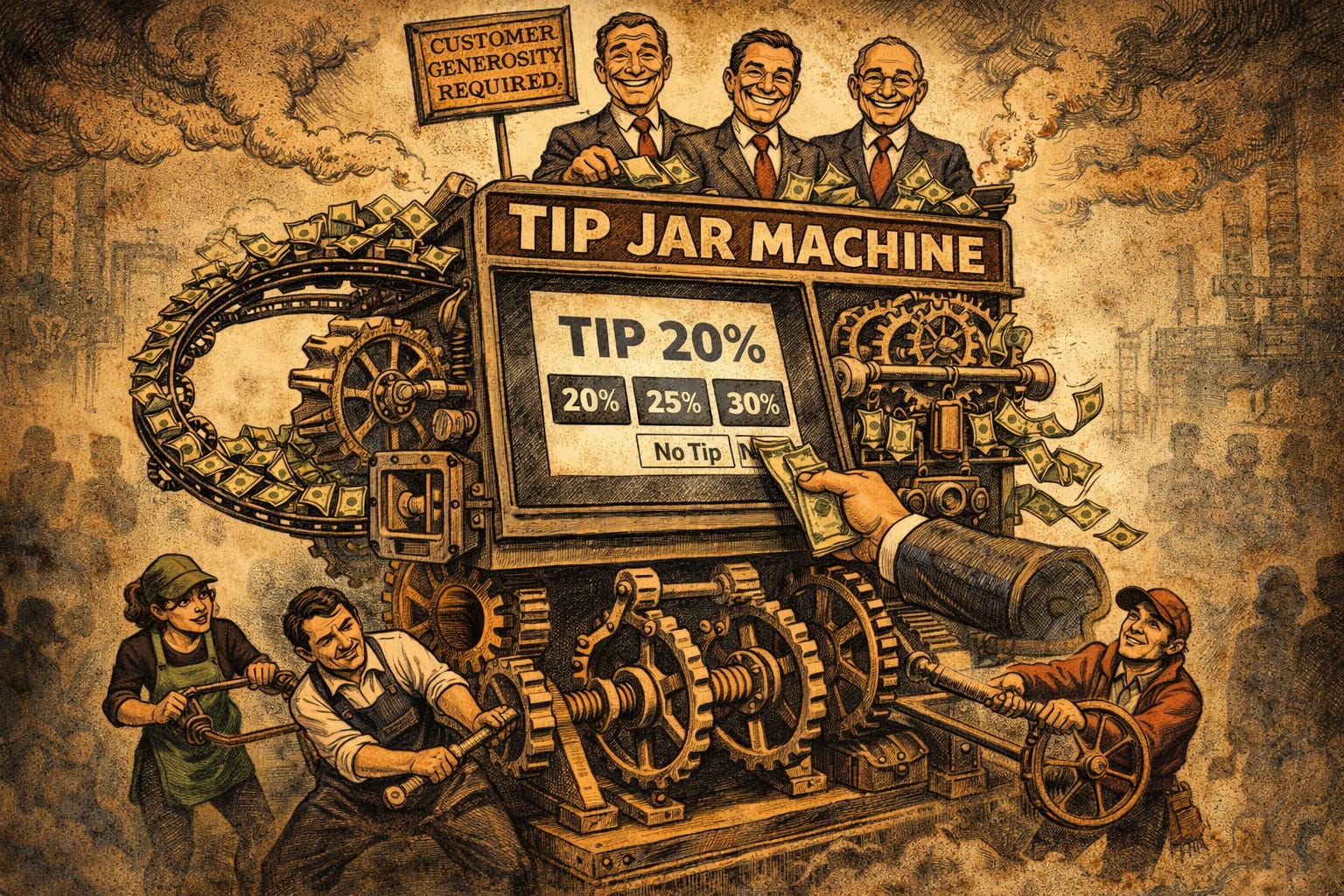
You don’t have to go far to see one. Digital tip screens are everywhere: coffee shops, bakeries, even self-checkout lanes. Most people think tips are a little something extra for great service. Those people are wrong.
Tips don’t supplement wages. They replace them.
Here’s the scam: In 15 states, your tip counts toward the employer’s minimum wage obligation. The employer pays as little as $2.13 an hour, legally, and your tips are expected to cover the rest.
In the remaining states, employers must pay the full federal minimum wage. But they use tips to justify never paying more than the minimum. “Why pay more when workers get tips?”
Different system. Same result.
You pay their employees.
Every time you tap that screen, you’re not being generous. You’re subsidizing a business model. You’re generating data that helps normalize a system designed to transfer employer costs directly onto you while keeping wages frozen.
The tip screen isn’t asking for kindness. It’s asking you to do the employer’s job.
The Math That Makes It Work
The federal tipped minimum wage is $2.13 per hour. That wage hasn’t moved since 1991. 34 years. Before 1991, the tipped minimum rose automatically as a percentage of the regular minimum wage.
Then Congress froze it. Permanently, as it turns out.
Here’s how the math works in the states still using this system. An employer pays you $2.13 per hour. Your tips must bring you to the full federal minimum—which is shockingly still just $7.25 per hour. Work an eight-hour shift and your employer pays you $17.04 total. Tips must cover the remaining $41 to reach minimum wage. That $41 is called the “tip credit”—a term doing an impressive amount of heavy lifting to avoid saying “this part of the wage is on you, the customer.”
The tip credit represents 71% of the full federal minimum wage. Seventy-one percent!
Want some perspective? In 1991, gas cost $1.14 per gallon. Movie tickets ran $4.75. Stamps cost 29 cents. Today those same things cost $3.50, $15, and 73 cents. The minimum wage for tipped workers is still $2.13.
The only other thing that hasn’t changed since 1991? The McRib keeps coming back at McDonald’s. So, you know, consistency.
The Human Cost of Frozen Wages
Tipped workers have a 12.8% poverty rate, compared to 6.5% for non-tipped workers. Nearly double. Two-thirds are women. The median wage for restaurant workers, including tips, is $10 per hour. If that sounds low, keep in mind that half make even less than that.
Among waitstaff, specifically, 18.4% live below the poverty line. Only 14.4% receive employer health insurance, compared to 48.7% of workers in other industries. Inconsistent schedules. No benefits. Constant income instability.
But good servers make it up in tips, right? Yeah, some do. But they’re the exception. The median is closer to $10 per hour. The system doesn’t run on the handful that earn double that on a Friday night. It runs on the millions making poverty wages on a Tuesday lunch shift.
Wage Theft Is the Business Model
So if workers don’t make minimum wage after tips, the employer has to make up the difference. Problem solved?
Not quite. According to the Economic Policy Institute, Department of Labor investigations of 9,000 restaurants found 84% had violated wage and hour laws. Nearly 1,200 violations were specifically of the requirement to bring tipped workers up to minimum wage. Workers were cheated out of $5.5 million in those investigations alone.
When 84% of investigated restaurants break the law, that’s not an enforcement problem. It’s a design feature. Stealing from workers is illegal the same way going 56 in a 55 MPH zone on the highway is—technically prohibited, practically encouraged, and realistically leading to zero tickets for speeding.
We have more rigorous enforcement for selling lemonade without a permit than we do for systematic wage theft. An eight-year-old with a folding table gets shut down faster than a restaurant stealing from its workers 10 out of 10 times.
The Racist Origins of “Customary Tipping”
Tipping wasn’t always an American thing. It spread widely after the Civil War, when businesses were looking for ways to hire freed Black workers without paying them a comparable wage to their white counterparts.
The clearest example: American industrialist George Pullman hired formerly enslaved Black men as railroad porters. In 1915, Pullman paid them $27.50 per month for 400 hours of work. 7 cents per hour. (That’s roughly $835 today or $2.09 per hour.) Tipping wasn’t a bonus on top of their pay, it was built into the pay structure from the start, explicitly designed to save the company money.
Carry a bag. Get a coin. Hope at the end of the day for heavy pockets. (Let’s not forget our current minimum wage for tipped employees still sits at just $2.13 per hour.)
Americans hated this. Six states temporarily banned tipping in 1915, calling it “aristocratic condescension incompatible with democratic values.” By the 1920s it was entrenched anyway. All of the bans got repealed.
America in 1915: “Tipping is un-American.”
America in 1925: “Actually, tipping is extremely American.”
We contain multitudes. Mostly contradictions.
Tip Creep Is Not an Accident
72% of Americans say tipping is expected in more places than five years ago. That instinct is correct, for what it’s worth. Only 34% say it’s easy to know when to tip. Only 33% know how much to tip. 40% oppose businesses suggesting tip amounts on screens. 72% oppose automatic service charges.
And yet…
92% tip at sit-down restaurants. Only 25% tip at coffee shops. And while that doesn’t sound like much, it’s climbing fast. Tip screens are becoming ubiquitous and it seems there’s a lot of confusion about when, or if, we should be using them to hand out tips.
The suggested amounts have shifted too. Historical norms for how much we should be tipping have hovered around 10-15%. 20% if the service was excellent. Now point of sale systems routinely suggest starting at 30% or higher.
They’re anchoring you. It’s the same trick car salesman use when they show you the $80,000 car to make the $50,000 one seem more reasonable. Except the car salesman isn’t watching you reject him in real-time while you’re trying to buy a muffin.
Can you just press “no tip?” Sure. But the worker’s watching. So are the people behind you in line. The pressure isn’t accidental. It’s the point.
The Conformity Engine
Tipping percentages evolved slowly for most of American history. Roughly 10% was the norm in the early 1900s. 15% by mid-century. 20% by 2000. What took 50-plus years to move from 10% to 15% later happened in about five years, going from 15% to 21% between 2019 and 2024.
Why the sudden acceleration? A theoretical model published in Management Science explains the mechanism. “Appreciators” tip above average to signal genuine gratitude. “Conformists” tip to match social norms and to avoid awkwardness. Appreciators pull conformists upward, establishing a new baseline. Then the cycle repeats.
During COVID, this went into hyper drive. Average tips increased 2-5 percentage points and stayed elevated. People wanted to support workers during a crisis, which is a noble impulse. Generous tipping then became socially expected behavior. That temporary generosity became our new permanent floor.
In less than a decade, we reached a point where 15%—the standard for excellent service in your parents’ day—now marks you as cheap.
How $30 a Month Redefines Employment
Every time you tip at a coffee shop, you’re creating evidence that customers will pay workers directly at that type of establishment.
This data can justify reclassifying entire job categories as “tipped positions” eligible for the $2.13 minimum wage. POS systems track everything: what percentage of customers accept suggested tip amounts, how often they override the defaults, and whether they choose to opt-out entirely, avoiding tipping at all.
When coffee shop workers routinely receive tips, employers can argue these workers are “customarily tipped.” Federal law is explicit here: Workers who receive more than $30 per month in tips can be classified as tipped employees.
That’s it. $30 a month. If a barista gets a single $2 tip per shift for 15 shifts a month, they’ve crossed the threshold. The employer could legally cut their base wage from $7.25 to $2.13 and call it compliance.
The more industries normalize tipping through screens, the more jobs become eligible for sub-minimum wages.
The Trap Has No Exit
Individual choices don’t matter when the system controls the interface. More than 70% of people oppose various aspects of tipping culture, but still participate. And why wouldn’t they? There’s no individual solution to a systemic problem.
Tips transfer wage obligations from employers to customers while generating the compliance data needed to expand that transfer to more industries. You’re not tipping generously; you’re subsidizing a business model and building the dataset to extend it.
The workers are trapped. The customers are trapped. The only ones who aren’t trapped are the people with the greatest incentives to keep it this way.
Congress could fix the $2.13 wage tomorrow. They could adjust the $30 threshold to account for 60 years of inflation. They could close the loopholes that let 84% of restaurants steal with impunity. They won’t, because the system is working exactly as intended.
Every tip screen is a small transfer of obligation from employer to customer, and every year that transfer gets a little bigger, a little more normalized, a little more irreversible.
You’re not watching a cultural shift. You’re watching a business strategy eat the economy, one payment terminal at a time.