

You know the routine. Open the app. Swipe. Match. Message. Maybe you meet. Maybe it goes nowhere. Maybe you delete the app for a week, then reinstall it at 11pm on a Tuesday—because what else are you supposed to do? Join a book club? Read the newspaper on a park bench and hope someone asks about your crossword? Actually strike up conversations with strangers? In this economy?
The apps promise connection. They deliver what feels like a second job.
Here’s the thing: Dating apps work. In 2019 39% of US couples met online. By 2020, 270 million adults worldwide had subscribed to a dating site. That’s 270 million people who decided to swipe right on disappointment. For context, it’s the entire population of Indonesia collectively deciding that meeting someone is too hard, let’s try algorithmic desperation.
But working and working for you aren’t the same thing. A review of 23 studies covering some 26 thousand users found that people on dating apps had worse psychological health than non-users. Worse. Not “about the same.” Measurably worse.
The apps aren’t failing. They’re just succeeding at goals that don’t align with yours.
How Success Became the Enemy
Match Group—which owns Tinder, Hinge, Match.com, OkCupid, and about forty others—generated $3.5 billion last year. Revenue actually grew 3%, which doesn’t sound like a lot until you consider that paying users dropped 5%. Revenue per user increased to 8%, about $19 per user.
Fewer customers, more money. Match Group isn’t expanding its base, it’s extracting more from the people already using its apps.
This creates the retention paradox. Netflix, for example, wants you to finish one show and start another. Dating apps? If they do their job well, you should leave forever. Delete the app. Stop paying. Get married and adopt a dog.
That’s “churn,” and every other business tries desperately to prevent it. But for dating apps, if their goals were aligned with ours, that’s exactly how they should work. Except that’s how you go bankrupt as a dating app.
Rotterdam researchers studied this exact problem. The apps faced tension between growing the network and growing revenue. The solution wasn’t optimizing for better matches; it was optimizing to maximize profitable users.
The apps could make more matches. The companies chose to make more money.
Want proof? In August 2025, Match Group settled with the FTC for $14 million. The charges? Sending users notifications about messages from accounts it had already flagged as fraudulent. Bots. Between June 2016 and May 2018, nearly half a million people subscribed within 24 hours of getting a notification that someone on the app was interested in matching with them.
The company knew the messages were fake. They sent them anyway.
The Gender Ratio Problem
Open Tinder. 75% of users are men. On Bumble, 67%. One analysis of 3,700 profiles found a consistent 2:1 ratio, at best, of men to women across platforms.
Women are roughly half the dating pool offline. Why are they a third of it online?
Simple answer: Platforms don’t recruit them. Women don’t have difficulty finding dates. They have difficulty finding qualified matches. And more dates doesn’t necessarily equal more qualified matches.
Real answer: The imbalance is more profitable.
Women have an average match rate of 30.7% on dating apps. Meaning, for every 3 people they like on an app, 1 will like them too. For men, it’s not quite as rosy. Men average 2.63% — a mere one reciprocated like for every 38 women they like on a dating app. Over the life of their app experience, men swipe right (like) an average of 16,368 times. Women? 2,283 times.
Different problems, same outcome: revenue. Men pay for boosts to solve scarcity. Women pay for filters to solve for overwhelming interest. Both are miserable, but both pay.
This is solvable. Match.com and eHarmony achieve near-50/50 ratios of men and women. Christian Mingle is 56% female. Even popular, yet imbalanced apps in the US are better elsewhere. Tinder’s ratio in Europe, for example, is near-50/50 — it’s 75/25 in the US (men/women). Same app. Vastly different ratios.
Apps that want balance achieve it. Apps that profit from imbalance maintain it.
The Algorithm Knows Who You’d Like. It’s Hiding Them.
Stanford researcher Daniela Saban partnered with a major platform to test its algorithm. Her modified version yielded 30% more matches. Nearly a third more matches from an algorithm tweak.
From this we can point to two truths. First, algorithms can be dramatically better than they currently are. Second, platforms choose not to improve them.
And if that doesn’t make you angry, this will. Saban’s team found that platforms track your matching success and use it to downgrade your shown profiles. Meaning, each match you get reduces your probability of seeing another quality prospect between 8% and 15%. When you’re succeeding, the algorithm’s job is to show you worse options. When you’re frustrated and thinking about giving up, it shows you the good ones.
The app knows which profiles you’d like. It knows. It has that information. It’s sitting right there in the database. But it withholds good matches until you’re unhappy enough to need them.
That’s not a bug. That’s not an oversight. That’s not “oops, our algorithm is still learning.” That’s a choice. That’s someone at Stanford proving it works 30% better, and someone in a boardroom saying: “Yeah, but what if we don’t do that? What if we make it deliberately worse? How much more money does that make us?”
And the answer, apparently, was “enough.”
Then there are the bots. The FTC lawsuit revealed that in some months between 2013 and 2016, more than half of instant messages users receive came from accounts Match had already identified as fraudulent. Match blocked these messages from paying members, then used them to advertise to its free users. Nearly 88% of the messages they sent during this campaign were later confirmed fraudulent.
The FTC found that 25% to 30% of daily Match.com registrations came from scammers. This wasn’t moderation failure. This was the business model.
Match settled for $14 million—0.4% of its annual revenue, which is essentially the FTC asking Match to Venmo them lunch money—noting that these practices “ended years ago.” You know, the way you “end” something after you’ve been caught, investigated for six years, and sued by the federal government. Except current estimates suggest up to 10% of profiles might still be fake.
A 2024 survey found 32% of users reported being catfished—talking to a user who was misrepresenting their identity.
Fake profiles inflate activity, keep free users engaged, generate notifications, and never lead to dates—but they succeed at keeping users on the app.
The matching tax. The bot economy. Both features, not bugs.
Variable Reinforcement, Dopamine Hits, and Monetized Desperation
These aren’t random choices. They’re components of architecture built to keep you coming back.
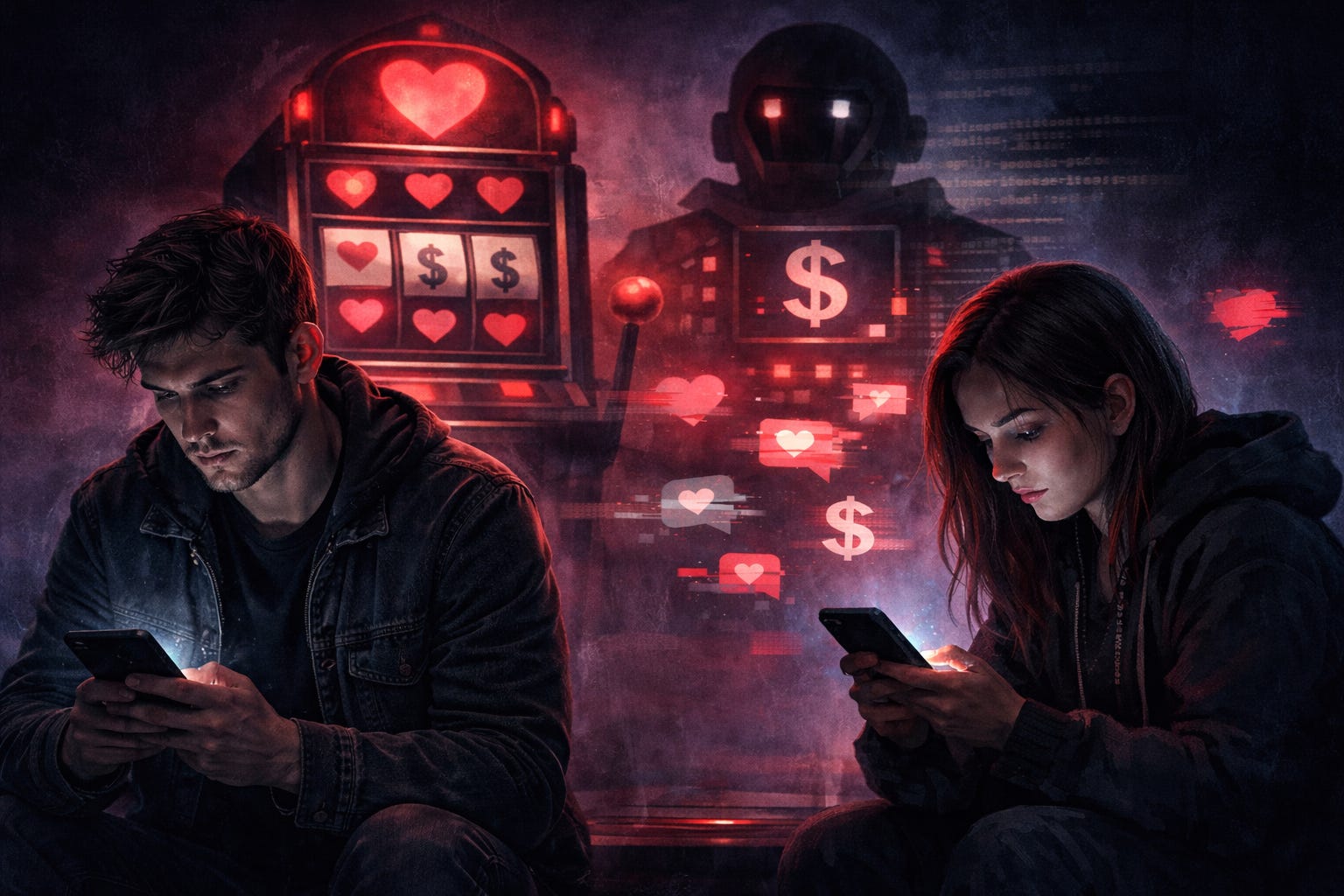
The apps use variable reinforcement, the slot machine mechanism. You don’t know which swipe yields a match, so you keep swiping. Insert coin, pull the lever, eventually the slot machine lights up and you win. Or so the thinking goes.
A pilot study found notifications predicted immediate mood improvements. Little dopamine hits. But increased time on apps predicted increased craving for more use—which is the literal progression of behavioral addiction.
Research published in JMIR Formative Research explicitly compared the business model to casinos: "Dating apps are like casinos in a way, in that they have to strategize where the reward needs to be—just enough to keep users coming back for more, but the reward cannot be so high that users walk away and not return. At least casinos have the decency to be honest about the odds. Slot machines don’t pretend they’re “designed to be deleted.”
A review of 29 papers found use patterns matching addiction criteria: salience, tolerance, conflict, relapse.
One study of 464 users aged 16-25 found frequent use led to excessive swiping, which led to upward social comparison, fear of being single, and partner choice overload.
The apps aren’t just failing to deliver relationships. They’re generating psychological distress in the process.
The Apps Hook the People Who Need Them Most
Arizona State researchers reviewed 23 studies, covering more than 26,000 users. Subjects had worse psychological health than non-users: more depression, more anxiety, and lower overall well-being.
Why do people keep using them? A survey of 521 users found the answer: hope. The desire for love and validation drives sustained engagement. The apps are most effective at hooking those who need them to work.
That’s the cruel efficiency of it all. You don’t open Instagram desperate for human intimacy. You don’t scroll TikTok hoping someone there might love you back. Dating apps are different because the stakes are different. People arrive vulnerable, looking for a connection that matters.
“Designed to be deleted,” Hinge promises. Meanwhile, the business model profits from keeping you in a state of perpetual, monetizable hope. “Designed to be deleted” the way a gym membership is “designed to get you fit”—technically possible, wildly improbable, and definitely not what keeps the lights on.
That’s not just extracting your attention. That’s extracting your vulnerability and selling it back to you as a monthly subscription.
The Platforms Aren’t On Your Side. They Never Were.
Dating apps aren’t failing. They’re succeeding at misaligned goals.
The FTC proved platforms use fake engagement for profit. Stanford researchers proved platforms throttle good matches during successful periods on an app. Gender imbalances persist despite proven solutions. Users show worse outcomes across two dozen studies.
None of this is accidental. These are strategic choices embedded in the business model.
A subscription business profiting from continued engagement will optimize for continued engagement. When your success means their customer leaves, the rational strategy is making success just hard enough to keep you trying, but not so easy you succeed and stop paying.
They accomplish this through structural choices (gender imbalance creating scarcity for men and overwhelm for women), algorithmic choices (withholding good matches during successful periods), and direct manipulation (bot notifications that drive conversations). Each problem looks fixable. Together, they form a system optimized for profit extraction.
The platforms are not on your side. They never were. That doesn’t mean they can’t facilitate real connections; obviously they do. It means those connections happen despite how the system is optimized.
The apps work. They could work considerably better. they choose not to because working better is less profitable.
And now you know why your dating life feels like a second job. The difference is your second job doesn’t pretend to be “designed to fire you” once you succeed at it. Although, to be fair, your second job probably also isn’t actively hiding qualified candidates from you while sending fake emails from robots to keep you showing up.
So... dating apps are actually worse than a second job. Congratulations, Match Group. You’ve achieved something truly special: you’ve made working feel better than dating.