

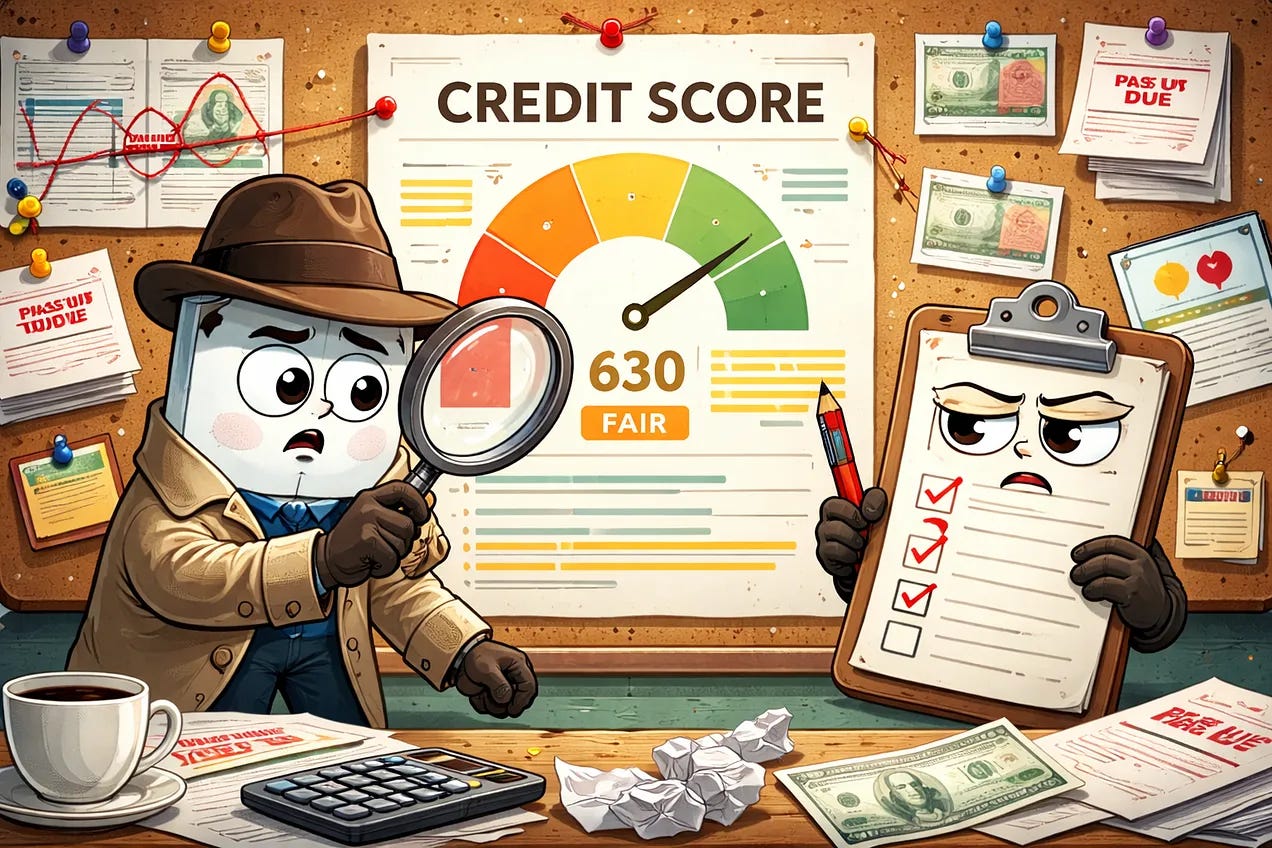
The optimal credit card utilization rate—the percentage that maximizes your credit score—is between 1% and 10%, and no more than 30%, ever.
Not zero percent. Not paid off completely. Slightly in debt. On purpose.
Ignore your credit entirely and your score suffers. Lean on it too hard and you’re labeled a risk. Maintain a balance of $100 on a $10,000 credit line? Chef’s kiss. Perfect. You need debt to prove you don’t need debt, which is exactly as nonsensical as it sounds. It’s like needing 10 years’ experience to get an entry-level job, except the entry-level job costs you 28% APR.
Can Arkali, a FICO executive, actually admitted this in an interview: there is nothing “optimal or significant” about that 30% utilization threshold everyone obsesses over. Nothing. No research backing it up. No mathematical justification. Just a number that became conventional wisdom through repetition. The entire system is built around using credit you don’t need, in amounts that have no empirical basis, to prove you’re responsible with money.
We’re all performing in a very expensive play, and nobody’s quite sure who wrote the script.
Credit Scores Don’t Measure Responsibility. They Measure Compliance.
Your FICO score breaks down like this:
Payment history: 35%
Credit utilization: 30%
Length of credit history: 15%
Credit mix: 10%
New credit inquiries: 10%
The average US score is currently 715, and 90% of lenders use FICO to decide whether you get approved. It’s the standard. The only standard that matters, really.
Now here’s what’s not in the calculation: your income, your savings, your investments, or whether you’ve paid rent on time for the last decade.
I’ll give you a second with that info.
The Federal Reserve found a “moderate positive correlation” between income and credit scores, sure—people with more money tend to have higher scores—but income itself isn’t a variable in the algorithm. You could have $100,000 in savings, a stable job pulling six figures, and zero debt. The current scoring system looks at this and responds the way a DMV clerk responds to joy: it doesn’t.
No credit history means no score. No score means no mortgage, probably no apartment, maybe even no job (depending on the employer). You’re Schrödinger’s borrower: simultaneously too risky to lend to and too responsible to have a score.
And rent? The thing that proves you can make a large payment on time, every single month, without fail? Only 13% of renters had it reported to credit bureaus in 2025. The other 87% could be paying thousands monthly, for years, and it’s completely invisible to the system. The Urban Institute found that rent reporting can boost scores and visibility, but landlords have no real incentive to report good news about tenants.
The Consumer Financial Protection Bureau states: 7 million Americans—2.7% of adults—are “credit invisible.” They have no credit file at all. It’s likely a significant portion of those would benefit from something as simple as adding rent, or even utility payments to the credit scoring system.
If credit scores aren’t measuring our ability to make timely payments, what exactly are they measuring then? Well, it’s not “Are you financially responsible?” so much as “Are you borrowing in a way that’s profitable for lenders?”
And those are two very different questions.
The Goldilocks Debt Zone
Credit utilization accounts for 30% of your FICO score. Everyone says to stay under 30% utilization, but if we look at the actual data: people with scores of 720 or higher average a 10.2% utilization. People with scores of 579 or below? They’re averaging 75.7%.
Let’s translate. If you have a $10,000 credit limit:
Pay it off completely, every month? Bad. The algorithm punishes you.
Max it out? Terrible. Obviously irresponsible.
Keep a small balance between $100 and $1,000? Perfect. Gold star. A+ credit behavior.
The sweet spot is being perpetually, slightly broke. On purpose. You have to keep yourself in a little bit of debt, but not too much, or too little. The Goldilocks debt zone.
It gets better. Another 10% of your score comes from something called “credit mix.” This is the algorithm rewarding you for having more types of debt. Just a mortgage? That’s fine, but not great. Mortgage plus a car loan plus a credit card? Now we’re talking. The system wants you to diversify your debt portfolio like an investment strategy, except you’re investing in owing money to different institutions, which is—double checks notes—not a great investment strategy.
Warren Buffett famously said “diversification is protection against ignorance.” The credit scoring system said “yes, exactly, now go get ignorant across multiple loan types.”
Let’s say you pay off your car loan. You’ve been making smart financial decisions, living within your means, not taking on unnecessary debt. This should be a win. In practice, it often lowers your credit score. Why? Because the system isn’t measuring responsibility so much as participation. Close an account, reduce your monthly payments, and you’ve given it less to track. The math changes. The judgment follows.
Credit Scores Don’t Just Measure Risk. They Create It.
Lower-income households aren’t just poorer. Their income is unstable. Hours vanish at work. Bills arrive uninvited. Cars break when they’re needed most. And there’s usually no savings cushion to soften the blow. Most Americans don’t even have $1,000 set aside for emergencies.
So here’s what happens in periods of emergency. A kid gets sick. Overtime hours aren’t available at work. You miss a credit card payment. Your score drops, sometimes dramatically. Your interest rates go up on everything. Now everything costs more precisely when you can least afford it. Higher-income borrowers can absorb the same mistakes. Same circumstance. Same late payment. Minor consequences.
Federal Reserve research shows that credit outcomes correlate strongly with income and neighborhood, even when payment behavior is identical. Where you live changes what that late payment means for your future. They call it “risk-based pricing.” You could also call it kicking people while they’re down, but algorithmically. And this isn’t a bug in the system—it is the system. It’s working exactly as designed.
The numbers are getting worse, too. FICO’s Fall 2025 report shows that the middle score range—600 to 749 FICO scores—shrank from 38.1% of Americans in 2021 down to 33.8% in 2025. People are moving to the extremes. The middle is disappearing. Gen Z—the youngest and least likely to absorb major financial blows—got hit the hardest with the biggest year-over-year drops.
We also saw evidence of this when student loan payments resumed after the pandemic pause. 6.1 million student loan holders (of 42 million) had delinquencies added to their reports between October 2023, when payments resumed, and May 2025 when lenders reinstated collection activities (including derogatory marks on your credit report).
The median score for low-income Americans sits at 658, in the “fair” range. Middle and high-income Americans, conversely, sit in the “very good” range of 740-799, on average. That gap translates to higher interest rates, larger security deposits, fewer housing options, and sometimes just flat-out rejection for loans, housing, or employment.
As it turns out, a system designed to assess risk ends up creating more risk for people who are already struggling. It is, indeed, more expensive to be poor.
The System Isn’t Broken. It’s Optimized For The Wrong Thing.
Viable alternatives already exist. We’re just not using them.
Rent and utility payment history. HUD research shows positive rent reporting leads to an average 23-point increase in credit scores. The data exists. The infrastructure exists. We’re just not prioritizing it.
Cash-flow underwriting. Some lenders are already doing this: analyzing your income and expenses instead of basing underwriting decisions mostly on FICO scores. Turns out it’s more accurate and more predictive of whether you’ll actually repay the loan. Wild.
Manual underwriting. Actual human beings evaluating the full financial picture. This is what we did for decades. We could do it again, especially for major purchase decisions like mortgages.
Limiting where scores get used. Stop using them for employment screening. Stop using them for insurance rates. Stop using them to decide if someone can rent an apartment. None of these uses have anything to do with creditworthiness; they’re convenient forms of discrimination that look objective because there’s a number attached. (Remember, credit scores predict debt-repayment behavior, not bill-paying behavior.)
Other countries are ahead of the curve and doing this already.
In the Netherlands, the BKR system is a national registry that records debts and arrears—it focuses on whether your obligations are manageable, not on generating a universal score that follows you everywhere.
In Japan, multiple bureaus provide credit files, but lenders emphasize employment stability and income over scores when making decisions.
Germany has SCHUFA, which provides credit reports, but housing decisions emphasize income verification and rental history alongside collected debt information.
These countries managed to avoid turning financial history into a permanent social credit score. We could learn something. We won’t, but we could.
How We Automated Human Bias
Credit scoring became widespread in the mid-20th century to standardize risk assessment. The explicit goal was replacing human judgment—which led to bias, especially in terms of race and gender—with automated systems that would be objective and fair.
And we did that. Kinda. We replaced human judgment with differently-biased automated systems. The difference is that discrimination by algorithm looks fair, clearer on paper, and free from bias. Math can’t be biased, right? It’s just numbers. Just data. Just… encoding the exact same structural inequalities that prejudiced loan officers once did, except now with a veneer of objectivity that makes it harder to challenge.
The current system was designed to optimize two things: risk tolerance and profitability. Not fairness. Not social mobility. Not economic justice. Risk and profit.
And it does those things incredibly well.
That’s why it won’t change. We have the tools. We have the data. We have working alternatives. The obstacle isn’t technical, it’s incentive. The institutions that built this system still benefit from it. Why would they change it?
The Real Purpose of a Credit Score
A credit score is not a moral judgment. It’s not a measurement of character. It’s not even measuring your financial responsibility. It’s a profitability estimate dressed up as a measure of trust to repay debt.
When a system rewards debt, penalizes financial stability, and treats caution as risk, the problem isn’t the people trying to navigate it. The problem is the system.
Remember the paradox: to build good credit, you have to use credit. But to use it responsibly, by the rules of the scoring system, you actually have to behave a little irresponsibly. The highest credit scores go to people who deliberately carry small balances, keeping themselves just short of paid-off, in amounts that are carefully optimized by an algorithm with no real connection to financial health.
We should probably stop pretending this is objective just because it comes with decimals. Math doesn’t make a system fair. It just makes it harder to argue with at a dinner party. But try explaining to someone that their credit score dropped because they paid off their car, and watch their face go through all five stages of grief in real time.
A thermometer tells you if it’s cold. It doesn’t decide whether you get a roof. Credit scores do. And somehow we’ve all agreed that it’s normal.