
Billionaires and the Infinite Money Glitch
How the ultra-wealthy borrow billions, pay nothing, and let death erase the bill.

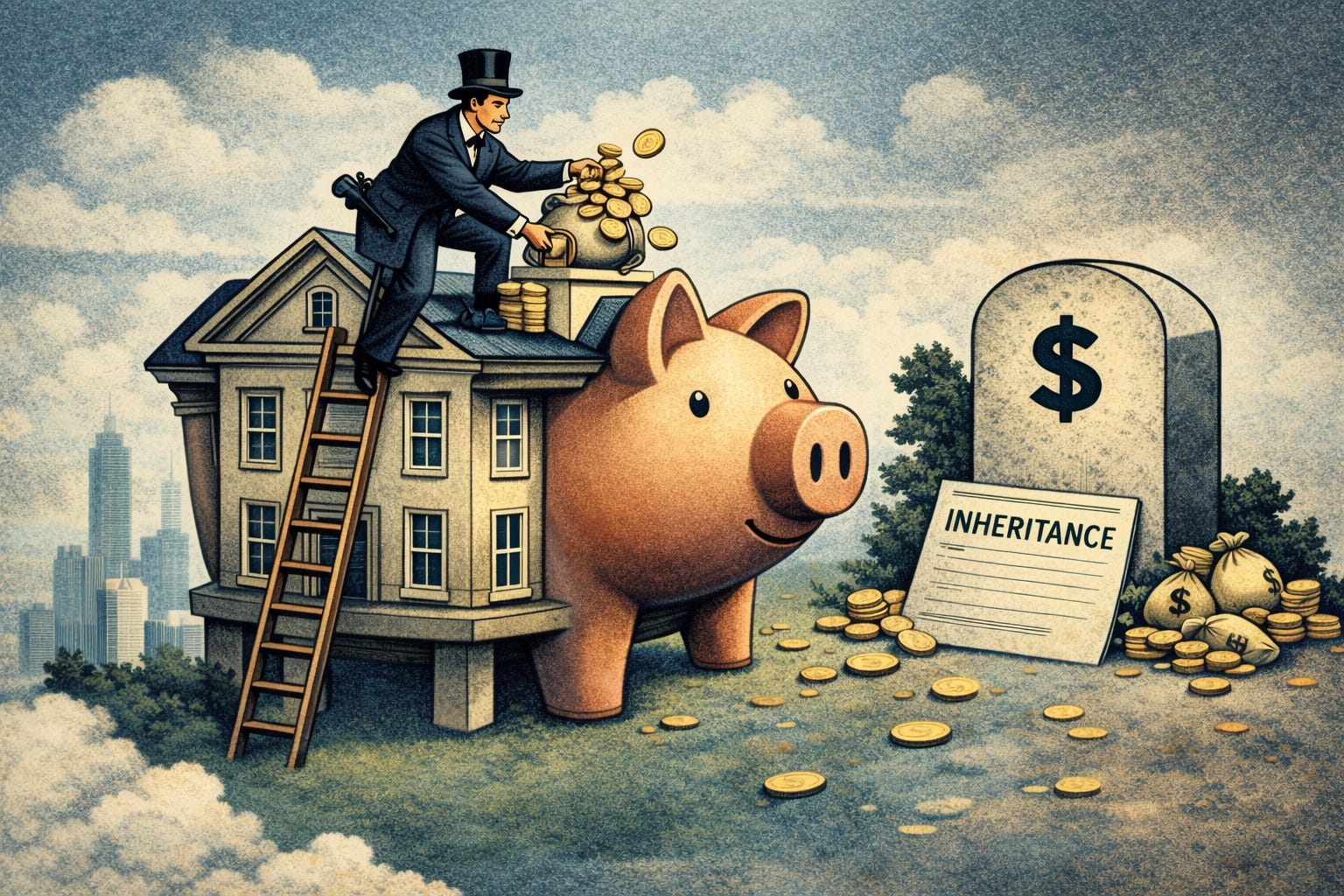
Jeff Bezos has taken out hundreds of millions of dollars in loans against his Amazon stock over the years. As of 2025, he still hasn’t paid back a dime of principal.
And he never will.
This isn’t a scandal. It’s not tax evasion. It’s how loans work when you’re worth $250 billion. Which is to say: they don’t work like loans at all.
Securities-backed lending now totals $175 billion. Billionaires live off these loans the way you live off your paycheck, except the loans never come due, never trigger taxes, and vanish when they die. (The billionaires die. The loans just evaporate, which is somehow more offensive.)
When you take out a $30,000 personal loan, you pay it back with after-tax income. You earn money, the IRS takes its cut, you use what’s left to repay the bank.
Bezos takes out a $500 million loan and… that’s it. That’s the whole transaction. The loan gets rolled over, refinanced, and eventually erased when he dies. Not because he’s richer, because the tax code treats his loan as a different species of financial instrument. Your loan has terms. His has suggestions.
The wealthy have figured out something the rest of us haven’t: Borrowing money isn’t the same as owing money. At least not if you borrow enough of it.
The Loan Isn’t Really a Loan
For normal borrowers, loans create obligations. For billionaires, loans create tax-free income.
Sell stock to buy a house? The IRS calls it a taxable event and takes its cut. Borrow $500 million against your stock? It’s a debt and you owe nothing.
Here’s how loans differ. Your auto loan has a 60-month term, fixed monthly payments, and an amortization schedule that chips away at principal every month. Miss a payment, your credit tanks. Miss three, they repo the car.
Billionaire loans don’t work like that. They’re built around flexibility, not terms. They’re interest-only, with no fixed maturity date. Pay us whenever. The bank doesn’t care because the collateral—real estate, businesses, or stock—keeps appreciating, making the loan safer every year.
When a loan matures, the billionaire doesn’t pay it off. They refinance into a new, larger loan, because the stock that was worth $500 million is now worth $700 million. The new loan pays off the old one, puts cash in their pocket, and resets the clock. Repeat until death.
This is the only context in which “rinse and repeat” ends with “and then die” and somehow that’s the best possible outcome.
The interest? Paid from stock dividends, taking out another loan, or just rolled into the balance. The principal? Never touched in their lifetime. Banks compete for these loans because they’re safe, and the terms just keep getting friendlier.
The strategy even has a name: Buy, Borrow, Die. The “die” part isn’t metaphorical. Death is when the entire scheme matures.
Most people try to avoid death. Billionaires found a way to make it tax-advantaged.
How “Buy, Borrow, Die” Actually Works
Three steps. Hiding in plain sight for over a century. All completely legal.
Step 1: Buy appreciating assets. This is the easy part if you founded Amazon or Tesla. Own things that grow in value (stocks, real estate, businesses) and never sell them. Selling triggers capital gains tax. Holding doesn’t.
This is why a lot of billionaires take $1 salaries. Wages trigger taxes. And wages are for suckers who need grocery money.
Step 2: Borrow against those assets. Banks and brokerages offer securities-backed lines of credit with terms you’ll never qualify for. They’ll lend 70% of your stock portfolio’s value, 90% if it’s in Treasury securities. Interest rates track the Secured Overnight Financing Rate (SOFR)—the base interest rate before banks add their cut—plus a small spread. This is far below the interest rate on your auto loan, your mortgage, or any debt you could qualify for.
Elon Musk pledged over $90 billion in Tesla shares as collateral for various loans. Larry Ellison has pledged 277 million Oracle shares, worth $82 billion, to secure personal loans. That’s more than the GDP of Slovenia, collateralized so an 80-year-old man can avoid paying taxes.
Step 3: Die. This is where it gets beautiful, from a tax-planning perspective.
When you die, your heirs inherit your assets at something called “stepped-up basis.” Under Internal Revenue Code Section 1014, the cost basis of inherited property resets to fair market value on the date of death.
Here’s how it works. You bought stock in 1990 for $100,000. By the time you die, in 2026, it’s worth $10 million. If you had sold it the day before you died, you’d owe capital gains tax on $9.9 million in appreciation.
But you didn’t sell. You died. And that changes everything.
Your heirs inherit the stock at a new cost basis: $10 million. Your original $100,000 purchase price? The IRS forgets it ever existed.
Now the estate sells stock to pay off your loans. But because the cost basis reset to $10 million, if your heir sells the stock to pay off your loan, the sale triggers zero capital gains tax. The $9.9 million you borrowed against for decades? Never taxed.
The IRS watches it walk out the door and shrugs.
When “Preventing Double Taxation” Prevents Single Taxation
Stepped-up basis had a purpose once. Congress wrote it into the Revenue Act of 1921, five years after creating the federal estate tax. The thinking was, if the government taxes an estate’s full value at death, it shouldn’t also tax the capital gains within the estate. That would be double taxation.
In 1921, this made sense. The estate tax kicked in at $50,000—roughly $900,000 today. Most substantial estates paid it. Stepped-up basis was the bargain: We’ll tax your estate, but we won’t also tax the gains made since you owned it.
That was then. Today, the federal estate tax exemption sits above $13 million per person. Only 0.1% of estates ever pay any estate tax. But 100% of heirs still get stepped-up basis. The provision that was supposed to prevent double taxation now prevents single taxation for 99.9% of the people using it.
The justification outlived its usefulness about 80 years ago, which makes it older than most of the senators voting to keep it… but just barely.
The Joint Committee on Taxation estimated that stepped-up basis cost the federal government $42 billion in 2021 alone. The Congressional Budget Office projects that replacing it would generate more than $110 billion over the next decade. That’s about what we spend annually on food stamps, except we’re giving it to dead billionaires’ heirs instead of hungry people.
Congress has tried to fix this. In 1976, it repealed stepped-up basis entirely. Four years later, it came back after businesses complained about record-keeping difficulties for old assets.
Obama proposed repealing it.
Biden proposed repealing it in three separate budgets.
Every proposal died without a congressional vote.
The 1921 loophole remains open in 2026 because the people who benefit from it are keeping it open. Which is impressive longevity for something that hurts 342 million Americans to protect roughly 700 families from paying their fair share of taxes.
What Billionaires Actually Pay
In 2021, ProPublica obtained a trove of IRS data covering thousands of America’s wealthiest individuals. What it found wasn’t surprising: The ultra-rich don’t just pay low taxes, they pay almost nothing. ProPublica calculated a “true tax rate” by comparing wealth growth to taxes paid.
Warren Buffett’s wealth grew by $24.3 billion between 2014 and 2018. He paid just $23.7 million in taxes. True tax rate: 0.1%. That’s not a typo. Ten cents for every hundred dollars of increased wealth. He paid less, as a percentage, than a Walmart cashier.
A teacher earning $60,000 pays roughly $8,500 in federal taxes, a 14% effective rate. Per dollar gained, that teacher paid 140 times Buffett’s rate.
And then there’s Jeff Bezos.
Bezos paid zero in federal income tax in 2007 and 2011. In 2011, when his wealth stood at $18 billion, he still claimed a $4,000 child tax credit. The credit is meant to help working families afford child care, or diapers. Bezos used it to reduce his tax bill from zero… to zero, but with a $4,000 refund.
None of this is illegal. It’s just the tax code doing exactly what it was built to do: Treat wealth and income as completely different things, then tax only one of them.
Too Rich to Audit
While billionaires pay nothing, the IRS audits people earning less than $25,000 annually at 5.5 times the rate of everyone else. Not because the poor cheat more. Because they’re cheaper to audit. These audits typically happen via mail, require less experienced agents, and lead to quicker recovery of funds—most often from miscalculations in the Earned Income Tax Credit (EITC).
Auditing a billionaire requires years of forensic accounting and lawyers that are often much more sophisticated than those employed by the IRS.
Natassia Smick is an interesting story that highlights the process. She earned $33,000 in 2017, and expected a tax refund of $7,300. Instead, the IRS froze it and spent 14 months auditing her over a $350 discrepancy.
During that same period, Bezos accessed billions in loan proceeds and paid zero in federal income tax. The IRS never questioned him. Not because borrowing billions while paying no taxes seemed less fishy. Because auditing Smick for 14 months costs less than auditing Bezos for a week.
70% Support. 0% Action.
70% of Americans support raising taxes on billionaires. Congress has done nothing. Not because reform is impossible. Because the people who’d pay those taxes fund the campaigns of the people voting on bills to raise or lower them.
President Biden proposed a 25% minimum tax on households worth over $100 million, affecting 10,700 people and raising $500 billion over 10 years. It was called “radical.”
One of Biden’s own fundraisers said it was a bill that was “dead on arrival and stupid to boot.” Senator Joe Manchin said, “You can’t tax something that’s not earned.”
Remember, unrealized gains aren’t “earnings,” even though you can borrow against them and spend that money like earnings. Apparently that’s a different thing.
Senator Ron Johnson of Wisconsin briefly threatened to vote no on the 2017 tax bill unless it included a larger deduction for pass-through businesses. He got his way. The expanded deduction netted two families $215 million in deductions in 2018. Those same families contributed $20 million to groups supporting Johnson’s reelection.
That’s a 2,500% return on investment for those keeping score at home.
This is how tax policy gets made. Billionaires fund campaigns. Senators insert provisions. Billions in tax savings flow to donors. The system sustains itself. Nobody is breaking the law. And it won’t change because those writing the laws are also the ones benefiting from it.
The Arguments Against Reform (And Why They Miss the Point)
The counterarguments against stepped-up basis, capital gains, or a wealth tax aren’t all in bad faith. Some are real problems. Understanding them explains some of the reasons reform keeps dying.
Constitutional questions abound. The Supreme Court has never ruled on whether taxing unrealized gains is constitutional. Wealth taxes may require apportionment by state population, which would make them unworkable. California, for example, would pay more than Wyoming even if the latter had 10x the number of billionaires. Good luck passing that. But, who knows? Constitutional law is the only field where “nobody knows” is a valid expert opinion.
Implementation is hard. No country taxes unrealized gains annually. Valuing public stock is easy, there’s a market price. Valuing privately held companies or an art collection? Harder. And what happens in down years? Does the Treasury cut refund checks to billionaires—actually, this might be the only thing that could kill the policy faster than lobbyists.
They do pay a lot… in absolute terms. The top 1% paid over $1 trillion in 2021, nearly half of all federal income tax revenue. Measured by total dollars, the system looks progressive. Measured in percentages of total wealth, less so.
Forcing asset sales could harm growth. If founders must sell stock annually to pay taxes on paper gains, they could lose a controlling interest in companies they built.
But here’s what those arguments miss. They’re defenses against a wealth tax. Eliminating stepped-up basis doesn’t require one. The IRS can allow this system to continue, collecting taxes upon death. Seems fair.
Remember how Buy, Borrow, Die ends: The billionaire dies, the estate sells assets to pay off the loans, heirs inherit what’s left. Under current law, stepped-up basis resets the cost basis to current value. Those sales trigger zero capital gains tax. The appreciation that funded decades of tax-free borrowing vanishes from tax rolls entirely.
End stepped-up basis and the math changes. Heirs inherit the original cost basis. When the estate sells assets to pay off loans, it pays capital gains on the full appreciation.
No constitutional issue, because you’re taxing realized gains.
No valuation problem, because there’s a documented sales price.
No forced sales beyond what already happens to settle the estate. And, if there’s enough liquidity in the estate, or cash to pay back the loans, no sale is required—the heir can simply refinance the asset with a new loan, after paying taxes and settling the existing debt.
The real reason stepped-up basis survives isn’t because it’s constitutional or practical. It’s that the 1921 bargain—we tax your estate, we don’t also tax the gains—quietly became a giveaway when the exemption rose from $50,000 to $13 million.
Two Tax Systems
Buy, Borrow, Die isn’t a tax loophole. It’s a parallel financial universe.
For most people, money is income. You earn it, it gets taxed, you spend what’s left. For the ultra-wealthy, money is collateral. It just has to sit there and exist.
Borrowing turns appreciation into spending power without ever having to sell.
Holding defers tax liability indefinitely.
Death wipes the balance sheet clean.
Stepped-up basis is where the trap door slams shut. Decades of untaxed gains—used as lifestyle fuel via loans—simply disappear when the debtor dies. Not deferred. Not discounted. Erased. What began as a protection against double taxation has become a guarantee of no taxation at all for the people wealthy enough to use it.
That’s why the debate gets so scrambled. Conservatives shout “wealth tax” when no one proposes one. “Small business” gets dragged into the debate from unrelated estate tax arguments. “Double taxation” echoes through chambers of congress even though, for nearly everyone using this strategy, there was never a first tax to double.
Ending stepped-up basis wouldn’t invent a new tax or punish business owners. It would just interrupt the final move in the Buy, Borrow, Die strategy. When assets are sold to settle loans, gains would be taxed the same way yours are.
No complex accounting. No new system. Just one rule in effect at the only moment money actually changes hands.
Your taxes feel oppressive because you live in a world where money has to move to be useful. Billionaires live in a world where money just has to exist. Loans become income, without ever being called income. Refinancing becomes routine. Death becomes tax deductible.
The glitch isn’t that billionaires found a loophole; it’s that we keep calling it a loophole after realizing it was how the whole system was designed.